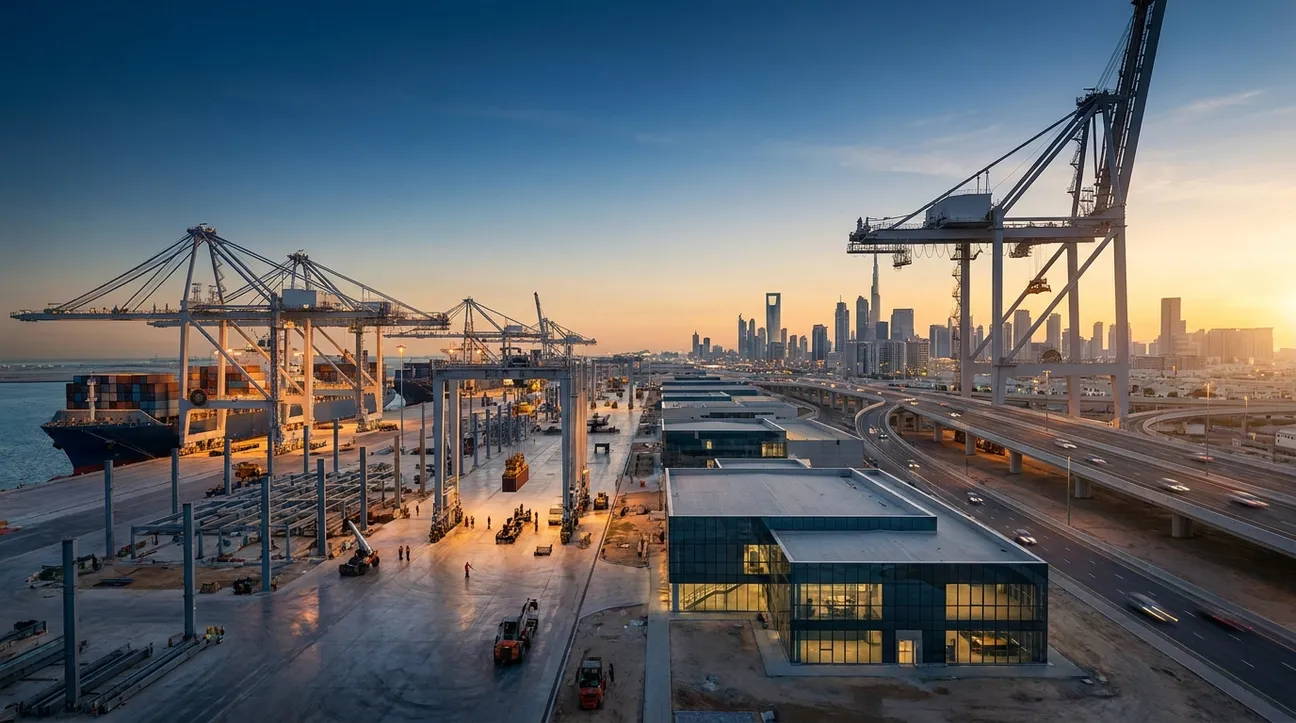
GCC industrial and logistics real estate crosses USD 1 billion threshold as institutional platforms multiply
Arcapita, Agility Global, and sovereign-adjacent vehicles compete for allocation in a sector projected to help drive GCC real estate to USD 260 billion by 2034.
Executive Summary
Key Takeaways
- Arcapita now manages over USD 1 billion in GCC industrial real estate across 3.5 million+ sq ft and 30+ properties, launching Lintara Properties as a dedicated asset manager.
- Arcapita plans to invest over USD 1 billion in logistics infrastructure in the US and UK, expanding beyond the Gulf.
- Agility Global operates an 871,000 sq m Riyadh logistics park with a SAR 250 million Grade-A warehousing expansion underway.
- The GCC real estate market is projected to reach USD 260.3 billion by 2034, with industrial and logistics assets capturing a growing share.
- Sovereign-adjacent vehicles and institutional LPs increasingly demand sector-specific logistics platforms.
A USD 141.2 billion market finds its next institutional frontier
The GCC real estate market reached USD 141.2 billion in 2025, according to IMARC Group, with the UAE commanding a 61.1% share. Yet the fastest-moving capital is flowing not into luxury towers or branded residences but into warehousing, last-mile logistics, and cold-chain infrastructure. At the center of this shift sits Arcapita, the Bahrain-headquartered investment firm that now manages over USD 1 billion in industrial real estate assets across the Gulf, comprising more than 3.5 million square feet across upwards of 30 properties leased to over 80 tenants, according to IFN Investor data from 2025.
The sector's institutionalization marks a structural pivot. Where industrial and logistics assets were once fragmented across family-owned portfolios, dedicated fund platforms and asset management vehicles are now emerging to professionalize the space, compete for sovereign and institutional allocations, and deliver risk-adjusted returns that rival hospitality and luxury residential.
How is Arcapita structuring its industrial real estate platform?
Arcapita's most significant organizational move in 2025 was the launch of Lintara Properties, a dedicated real estate asset manager and developer created to manage both existing and future GCC industrial real estate funds, according to an Arcapita press release from October 2025. The creation of a standalone entity signals that Arcapita views industrial logistics as a permanent allocation category rather than an opportunistic play.
Lintara Properties is designed to localize asset management, bringing operational oversight closer to the tenant base and physical infrastructure that define the sector. With over 80 tenants spread across more than 30 properties, the platform requires granular lease management, capex planning, and tenant retention strategies that differ fundamentally from residential or hospitality portfolios.
Arcapita's ambitions extend well beyond the Gulf. The firm announced plans at the Gateway Gulf Investment Forum in November 2025 to invest over USD 1 billion in logistics infrastructure, including industrial warehousing and datacenters, across the United States and the United Kingdom over the following year. This dual-geography strategy positions Lintara as a platform capable of deploying capital across multiple regulatory environments and currency zones.
The competitive advantage of a dedicated industrial platform lies in its ability to attract institutional limited partners who seek sector-specific exposure. Industrial and logistics real estate offers characteristics that are increasingly attractive to sovereign wealth funds and large family offices: long-duration leases, inflation-linked rental escalations, and structural demand tailwinds from e-commerce penetration and supply chain localization.
What role does Agility Global play in the GCC logistics real estate landscape?
Agility Global PLC reported FY 2025 revenue of USD 5.1 billion and total assets of USD 13.4 billion, according to the company's February 2026 disclosure. While Agility operates across multiple verticals, its logistics parks division has become a defining force in GCC industrial real estate infrastructure.
Agility Logistics Parks operates an 871,000 square meter logistics park in Riyadh and is delivering a SAR 250 million expansion to add 100,000 square meters of Grade-A warehousing, according to Agility Global's November 2025 announcement. This expansion aligns directly with Saudi Arabia's Vision 2030 objectives, which prioritize supply chain sovereignty and the development of non-oil economic infrastructure.
The scale of Agility's physical footprint distinguishes it from fund-based competitors like Arcapita. Where Arcapita channels institutional capital into diversified industrial portfolios, Agility builds and operates the infrastructure itself, creating a vertically integrated model that captures value across development, leasing, and facilities management. These two approaches represent complementary rather than competing strategies, and both are essential to the sector's maturation.
Grade-A warehousing remains undersupplied across major GCC markets. Commercial office supply across the region is estimated to expand from 33.3 million square meters in 2025 to 42.4 million square meters by 2030, with over 65% of new supply concentrated in Saudi Arabia and the UAE, according to Alpen Capital. While this projection covers office space, it illustrates the broader trajectory of institutional-grade commercial development that is pulling logistics and industrial assets into the same capital markets framework.
The competitive landscape: conglomerates and sovereign-adjacent capital
The GCC's industrial and logistics real estate ecosystem extends beyond pure-play logistics platforms. Mid-tier conglomerates with vertically integrated real estate footprints are entering adjacent segments, building operational scale that could eventually support dedicated logistics allocations.
AIMS Holding, a Saudi conglomerate, exemplifies this trajectory. The firm collaborated with IHG Hotels & Resorts to develop the first Regent-branded hotel in Makkah, according to Gulf Property in October 2025. While the project sits squarely in the hospitality segment, it reflects the kind of vertically integrated development capability that can be redirected toward industrial and logistics assets as market conditions evolve.
On the institutional capital side, sovereign-adjacent vehicles play a crucial channeling role. Aventicum Capital Management (Qatar) LLC, a joint venture involving the Qatar Investment Authority, operates as a multi-asset management boutique directing institutional capital into real estate and equities, according to Private Banker International. Entities like Aventicum serve as conduits through which Gulf sovereign wealth reaches specialized asset classes, including industrial logistics, that may lack the brand recognition of luxury residential or hospitality but deliver compelling risk-adjusted performance.
The interplay between sovereign capital, family office allocation, and dedicated fund platforms defines the competitive dynamics of this sector. Institutional LPs increasingly demand sector-specific vehicles with transparent fee structures and local operational expertise, precisely the kind of platform that Arcapita's Lintara Properties aims to provide.
How large can the GCC industrial real estate allocation become?
The IMARC Group projects the overall GCC real estate market to reach USD 260.3 billion by 2034, exhibiting a compound annual growth rate of 7.03% during the 2026-2034 period. Industrial and logistics assets are positioned to capture a growing share of this expansion.
Several structural forces support this thesis. E-commerce penetration across the Gulf continues to accelerate, driving demand for last-mile fulfillment centers and temperature-controlled warehousing. Supply chain localization, a strategic priority for Saudi Arabia and the UAE, requires purpose-built logistics infrastructure that meets international specifications. The datacenter buildout, which Arcapita has explicitly targeted in its USD 1 billion US and UK investment plan, represents a convergent asset class that blends industrial real estate fundamentals with technology infrastructure demand.
Kuwait's real GDP is projected to grow by 3.9% year-on-year in 2026, according to Markaz (Kuwait Financial Centre), a pace expected to support demand for commercial and industrial real estate. While Kuwait has historically lagged the UAE and Saudi Arabia in logistics infrastructure development, its growth trajectory suggests emerging opportunities for fund platforms seeking diversification within the GCC.
The sector's maturation is also visible in how industry leaders discuss capital allocation. At recent GRI Institute gatherings focused on Gulf real estate, senior executives from across the region have identified industrial and logistics assets as a distinct institutional category, separate from the hospitality and luxury residential segments that have traditionally dominated GCC real estate discourse. This recognition reflects a broader shift in how institutional investors evaluate the Gulf's real estate opportunity set.
The institutional inflection point
GCC industrial and logistics real estate has reached an inflection point. The creation of dedicated asset management platforms like Lintara Properties, the expansion of Grade-A warehousing by operators like Agility Global, and the increasing willingness of sovereign and institutional capital to allocate to the sector all point in the same direction: logistics real estate is becoming a core institutional asset class in the Gulf.
The sector's competitive landscape is stratified. At the top sit dedicated fund platforms and large-scale operators with billion-dollar portfolios. In the middle, vertically integrated conglomerates build optionality across real estate segments. And behind them, sovereign-adjacent capital vehicles provide the institutional plumbing that connects Gulf wealth to specialized investment opportunities.
For institutional investors evaluating the GCC, the industrial and logistics segment offers a differentiated return profile. Long lease durations, creditworthy tenant bases, and structural demand growth create a combination of yield stability and capital appreciation potential that few other real estate segments in the region can match. As the GCC real estate market advances toward its projected USD 260.3 billion valuation by 2034, the platforms that have built operational scale and institutional credibility in logistics and industrial assets will be best positioned to capture the next wave of allocation.
GRI Institute continues to track the evolution of this asset class across its Gulf real estate programming, connecting senior leaders from fund platforms, operators, and institutional investors to map the sector's development in real time.