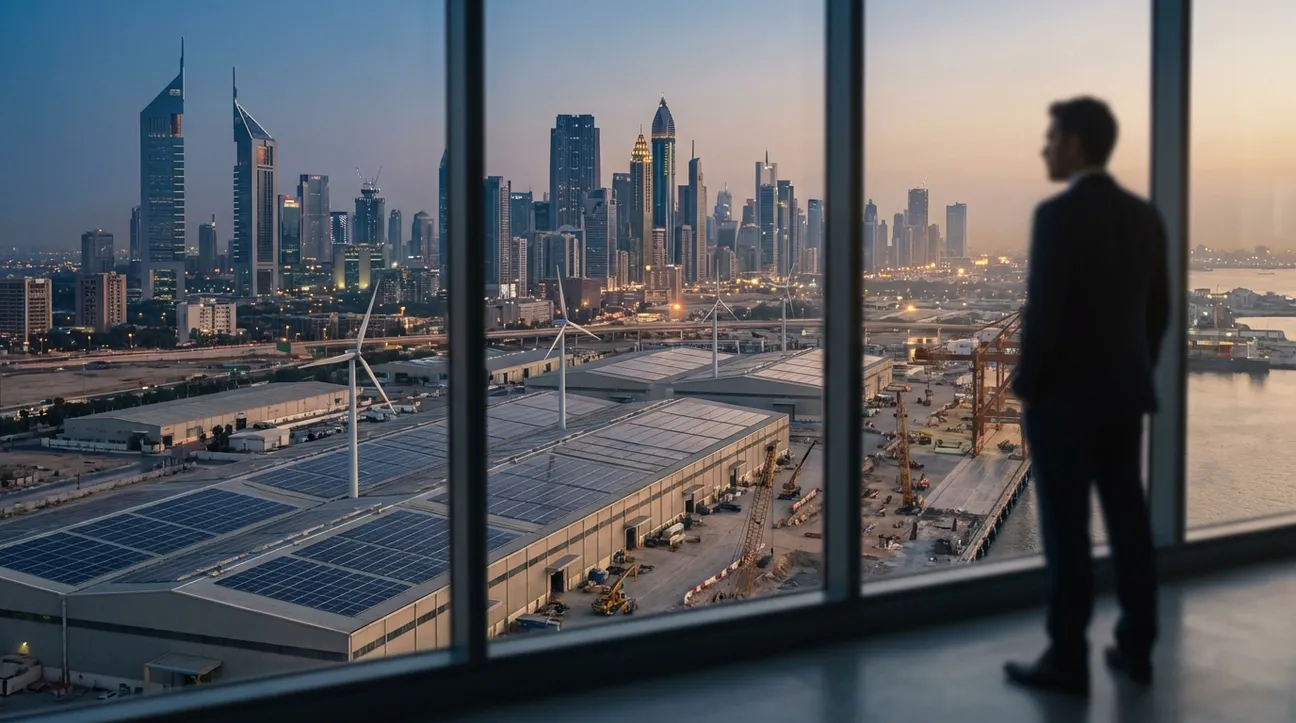
Energy-linked real estate in India: capital vehicles, deal structures and pipeline through 2028
From Avaada's Noida gigafactory to ReNew's leadership transition, a data-driven look at the operators shaping India's renewable-real estate corridor.
Executive Summary
Key Takeaways
- India's renewable energy market is projected to reach $52.58 billion by 2034, driving massive demand for industrial real estate including manufacturing campuses, data centers and logistics corridors.
- Avaada Group's rapid buildout of 1.5 GW and 5 GW solar facilities in the Noida region signals urgent demand for purpose-built industrial land.
- The ALMM expansion (effective June 2026) will create compliance-driven demand for certified manufacturing facilities and industrial parks.
- Data center investment of two lakh crore rupees over the next decade is accelerating co-location of renewable energy and real estate assets.
- Cross-border European green finance vehicles are increasingly targeting India's energy-linked real estate sector.
India's renewable energy market is projected to reach $52.58 billion by 2034, according to IMARC Group. That figure represents more than an energy story. It signals a massive real estate buildout, one that demands manufacturing campuses, data center parks, logistics corridors and land banks calibrated to clean power infrastructure. The capital vehicles and operators positioning themselves at this intersection of energy and real estate are drawing growing attention from institutional investors, developers and cross-border financiers.
This market radar maps the emerging players, verified deal activity and structural dynamics shaping India's energy-linked real estate corridor.
Avaada's Noida expansion: the physical footprint of India's solar manufacturing push
Avaada Group inaugurated a 1.5 GW solar module manufacturing Gigafactory in Noida, Uttar Pradesh, completing construction in just 3.5 months, as reported by The Economic Times in March 2025. The speed of execution itself underscores the urgency embedded in India's renewable manufacturing calendar and the corresponding demand for ready industrial real estate.
Avaada has also laid the foundation for a 5 GW integrated solar manufacturing unit spread over more than 50 acres in Ecotech-16, Greater Noida, according to EQ Mag Pro (March 2025). These two facilities represent a concentrated industrial real estate footprint in the National Capital Region that combines manufacturing scale with proximity to logistics infrastructure.
The expansion of solar manufacturing at this pace creates direct demand for industrial land, warehousing, worker housing and ancillary commercial development. Every gigawatt of manufacturing capacity requires a corresponding real estate envelope, spanning factory floors, cleanrooms, testing facilities, staff quarters and supply chain nodes.
India's renewable manufacturing corridor is generating a new category of industrial real estate demand that traditional commercial developers have only begun to address.
How is the ALMM expansion reshaping land and manufacturing strategy?
The Ministry of New and Renewable Energy (MNRE) will add solar cells to its Approved List of Modules and Manufacturers (ALMM), with the expansion effective June 2026. This regulatory shift sets the parameters by which solar projects can benefit from government procurement and incentives, directly influencing where and how manufacturers invest in physical infrastructure.
For real estate operators and land aggregators, the ALMM expansion carries significant implications. Manufacturers seeking ALMM certification will need compliant facilities, which translates into demand for purpose-built industrial parks, greenfield land parcels near logistics corridors and infrastructure-ready special economic zones. The regulation effectively creates a compliance-driven demand curve for industrial real estate in states that offer both policy support and physical infrastructure.
States such as Uttar Pradesh, Rajasthan, Gujarat and Tamil Nadu, which already host renewable manufacturing clusters, are likely to see intensified competition for industrial land parcels that meet the technical specifications required for ALMM-certified production.
ReNew Energy Global: a leadership transition with real estate implications
Balram Mehta, COO and Group President of Asset Management at ReNew Energy Global, announced his departure effective March 31, 2026, after over 14 years with the company, as reported by The Economic Times and confirmed through SEC filings in February 2026.
Mehta's tenure at ReNew coincided with the company's transformation from a domestic independent power producer into a global platform with substantial asset management operations. His exit marks a significant leadership transition at a moment when ReNew's portfolio, spanning operational renewable assets, land holdings and development pipelines, requires strategic continuity.
The asset management function at a renewable energy company of ReNew's scale inherently involves real estate decisions: site selection, land acquisition, lease structuring, right-of-way negotiations and community engagement across hundreds of project locations. A leadership change at this level introduces a period of recalibration that investors and joint venture partners will monitor closely.
The departure of a senior asset management leader at one of India's largest renewable platforms signals both the maturity of the sector and the competitive demand for executives who understand the intersection of energy operations and real estate strategy.
What role do cross-border capital vehicles play in India's energy-linked real estate?
Martin Soell, Director of Real Estate Finance at Natixis Pfandbriefbank AG, represents a category of cross-border capital that evaluates Indian real estate through a sustainability lens, as noted in GRI Hub coverage from March 2026. European institutional lenders and covered bond issuers have increasingly incorporated ESG criteria into their underwriting frameworks, and India's renewable infrastructure buildout offers a natural alignment.
Cross-border capital vehicles bring several structural advantages to India's energy-linked real estate market: longer investment horizons, lower cost of capital in certain tranches and familiarity with green bond and sustainability-linked financing instruments. For Indian developers and renewable operators seeking to monetize land banks or co-develop industrial campuses, partnerships with such vehicles offer both capital and credibility with global institutional allocators.
GRI Institute has convened discussions among senior real estate and infrastructure leaders on precisely this theme, exploring how sustainability-linked capital flows are reshaping development models across emerging markets. The convergence of European green finance frameworks with Indian renewable manufacturing demand represents one of the more structurally compelling investment themes in the current cycle.
RRC Ventures: search interest outpaces public disclosure
RRC Ventures Pvt Ltd is a Mumbai-based construction service provider with an estimated turnover of 100 to 500 crore rupees, according to IndiaMart (2026). The company has attracted notable search interest, with data indicating a click-through rate of approximately 5 percent on related queries, suggesting that market participants are actively seeking information about its operations and positioning.
However, no verified public data currently connects RRC Ventures to institutional energy-linked real estate capital vehicles or large-scale renewable infrastructure projects. The gap between search interest and available market intelligence highlights a broader pattern in India's mid-market construction and development sector: operators with meaningful regional presence and revenue often lack the public disclosure frameworks that institutional investors require for due diligence.
For capital allocators evaluating India's energy-linked real estate buildout, the information asymmetry surrounding mid-market operators represents both a risk and an opportunity. Firms that move toward greater transparency in their deal structures, project pipelines and partnership models will be better positioned to attract institutional capital as the sector scales.
Data centers: the clean power imperative driving real estate demand
India's data center investment pipeline is projected at two lakh crore rupees over the next decade, according to GRI Hub. This pipeline carries a direct and growing requirement for dedicated clean power, linking data center real estate development inextricably to renewable energy infrastructure.
Data center campuses require reliable, high-capacity power supply, and hyperscalers increasingly mandate renewable energy sourcing as a condition of site selection. This dynamic creates a co-location logic: renewable generation assets, transmission infrastructure and data center campuses converging on the same land corridors. States that can offer both power infrastructure and real estate readiness will capture a disproportionate share of this investment.
The data center sector's clean power requirement is accelerating the convergence of energy infrastructure and real estate development into a single investment thesis, one that demands integrated planning across both asset classes.
Pipeline outlook through 2028
The verified data points, spanning Avaada's multi-gigawatt manufacturing expansion, ReNew's leadership transition, the ALMM regulatory shift and the projected growth of India's renewable energy market to $52.58 billion by 2034, collectively outline a sector moving from early-stage opportunity to structured institutional deployment.
Several dynamics will define the pipeline through 2028. First, regulatory clarity from the ALMM expansion will channel manufacturing investment toward compliant industrial real estate. Second, leadership transitions at major platforms like ReNew will reshape partnership structures and asset management strategies. Third, cross-border capital vehicles will deepen their engagement with Indian energy-linked real estate as ESG frameworks mature. Fourth, the data center buildout will intensify demand for co-located renewable power and real estate assets.
GRI Institute continues to track these developments through its convening of senior leaders across real estate and infrastructure. The energy-linked real estate corridor in India is no longer a thematic niche. It is becoming a primary channel for institutional capital deployment, with verified deal activity and regulatory momentum that demand sustained analytical attention.
For market participants seeking to map the capital vehicles, operators and structures shaping this corridor, the imperative is clear: granular, deal-level intelligence will separate informed positioning from speculative exposure.