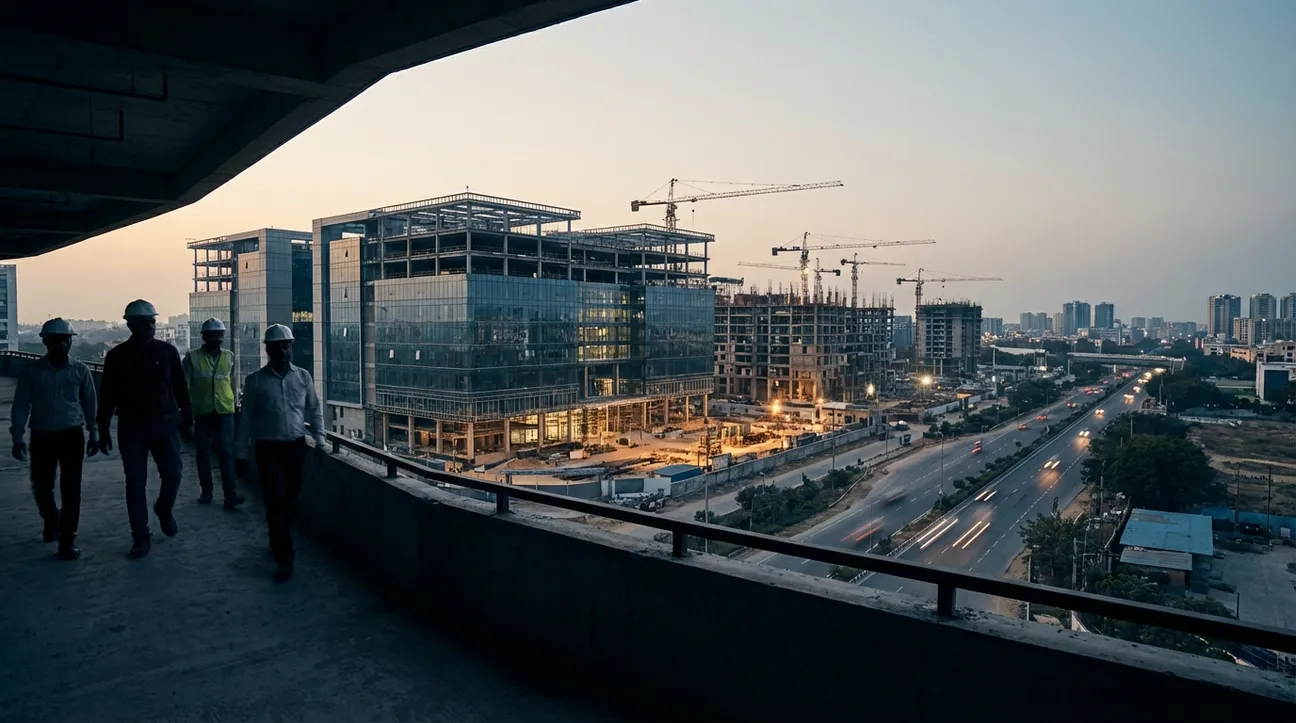
Eldeco's ownership structure and the family capital blueprint scaling Uttar Pradesh's institutional real estate corridor
How Pankaj Bajaj's stewardship of Eldeco Group, backed by HDFC Capital, is redefining the developer-platform model across North India's fastest-growing cities.
Executive Summary
Key Takeaways
- Pankaj Bajaj's Eldeco Group partnered with HDFC Capital to develop 18 residential projects spanning 10M+ sq ft across Tier 2 and Tier 3 North Indian cities.
- Family-owned developer platforms with institutional backing are emerging as the most capital-efficient model for scaling housing in India's secondary cities.
- UP RERA's 2026 amendments strengthen buyer protection and enhance institutional investor confidence in Uttar Pradesh's real estate corridor.
- Premium homes above ₹1 crore now account for 50% of India's annual residential sales, signaling rising aspirational demand.
- Eldeco and Elan Group illustrate divergent family capital strategies: geographic diversification vs. asset-class breadth.
The family behind Eldeco and the institutional turn reshaping North Indian real estate
When investors and market observers search for the name behind Eldeco, they find a story that extends well beyond a single founder. Pankaj Bajaj is the Chairman and Managing Director of Eldeco Group. He joined the group in 1996 and founded Eldeco Infrastructure & Properties in 2000, building one of the most recognizable residential development brands across Uttar Pradesh over the span of more than two decades. His leadership has steered Eldeco from a regional homebuilder into a platform increasingly attractive to institutional capital, a trajectory that carries wider implications for how family-owned Indian developers are evolving.
The Indian residential market is entering a phase where institutional partnerships and regulatory clarity are converging to reward disciplined, governance-driven operators. Eldeco's recent alliance with HDFC Capital Advisors, one of the country's most active real estate investment platforms, exemplifies this shift. According to VCCircle and The Economic Times, HDFC Capital created a development platform with Eldeco Group to develop 18 residential projects in Tier 2 and Tier 3 cities. As reported by the Hindustan Times, the platform targets a total development area of over 10 million square feet across North Indian cities, with a substantial combined revenue potential.
This partnership is significant for several reasons. It validates the governance architecture that Bajaj has built within a family-owned structure, making it legible and trustworthy to institutional limited partners and fund managers. It also signals that the next frontier of Indian residential development lies outside the top eight metropolitan cities, in the rapidly urbanizing corridors of states like Uttar Pradesh.
Who owns Eldeco Group, and why does its governance model matter for institutional capital?
Pankaj Bajaj's ownership and operational leadership of Eldeco Group positions it within a distinct category of Indian real estate companies: family-controlled platforms that have deliberately professionalized their governance to attract institutional co-investment. This model is neither a legacy family business resistant to outside capital nor a fully institutionalized listed entity. It occupies a middle ground that is becoming increasingly relevant as global and domestic fund managers seek scalable development partners in India's secondary cities.
The significance of this structure becomes clear when examined alongside the broader market context. India's GDP growth estimate for FY 2026 was revised upward to 7.3% by the Reserve Bank of India, according to Knight Frank India, providing a strong macroeconomic foundation for real estate markets. Within this environment, premium homes priced above ₹1 crore accounted for 50% of India's annual residential sales in 2025, following a 14% year-on-year increase, as Knight Frank India reported. Total residential sales reached 348,247 units across India's key markets in 2025.
For a developer like Eldeco, the combination of macro tailwinds and rising aspirational demand in cities such as Lucknow, Noida, and other emerging UP corridors creates an expansive addressable market. The HDFC Capital partnership, structured around 18 projects and over 10 million square feet, is designed to capture precisely this demand.
Family-owned developer platforms with institutional backing represent one of the most capital-efficient vehicles for scaling residential delivery in India's Tier 2 and Tier 3 cities. The family provides local market intelligence, land sourcing capability, and brand equity accumulated over decades. The institutional partner provides structured capital, financial discipline, and portfolio-level risk management. Together, they achieve something neither could accomplish alone.
GRI Institute's engagement with senior leaders across India's real estate ecosystem has consistently surfaced this theme: the most promising growth in Indian residential development is occurring at the intersection of family entrepreneurship and institutional governance. Participants in GRI Institute's India-focused forums have identified family capital platforms as a structural feature of the market, distinguishing India from more institutionalized markets in Southeast Asia or the Middle East.
How does Eldeco's capital strategy compare to other family-led North Indian developers like Elan Group?
Eldeco is not the only family-controlled developer scaling operations through institutional partnerships in North India. Elan Group, led by Rakesh Kapoor as Chairman, has built a prominent commercial and mixed-use development platform primarily focused on Haryana's Gurugram corridor. While Elan's strategic orientation has leaned toward commercial and retail-led mixed-use projects, Eldeco under Bajaj has concentrated on residential delivery across a wider geographic spread.
The comparison illuminates two distinct approaches to the family capital model. Elan Group operates with Rakesh Kapoor steering the company's vision alongside Ravish Kapoor as Managing Director, creating a multi-generational family leadership structure focused on a concentrated geography but diversified asset classes. Eldeco, by contrast, has pursued geographic diversification within a singular asset class focus, residential, now amplified by the scale that HDFC Capital's platform provides.
The divergence between Eldeco and Elan illustrates that there is no single family capital playbook in Indian real estate; the optimal model depends on whether a family's competitive advantage lies in geographic depth or asset-class breadth. Both approaches attract institutional interest, but for different reasons. Geographic diversification, as in Eldeco's case, appeals to investors seeking exposure to India's urbanization story beyond the saturated metros. Asset-class diversification, as in Elan's case, appeals to investors seeking yield-generating commercial portfolios.
For institutional investors evaluating North Indian exposure, understanding the ownership structures and strategic orientations of these family platforms is essential due diligence. The founding family's capital allocation philosophy, governance norms, and succession planning directly affect the risk profile and return trajectory of any co-investment.
What role does regulation play in enabling Eldeco's expansion across Uttar Pradesh?
The regulatory environment in Uttar Pradesh has matured considerably, adding a layer of institutional confidence to the market that Eldeco is expanding into. The UP RERA 10th Amendment to the General Regulations of 2019, which came into effect on March 25, 2026, amends Regulations 24 and 47 to allow allottees of unregistered projects to approach UP RERA for grievance redressal. The amendment also caps administrative charges levied by promoters during property transfers, setting limits of ₹1,000 for family members and ₹25,000 for non-family members.
These regulatory developments carry direct commercial implications for Eldeco's strategy. By strengthening buyer protection and reducing friction in property transfers, UP RERA's latest amendments improve the market's credibility with end-consumers and, by extension, with institutional investors. A transparent regulatory framework reduces the risk of project-level disputes and enhances the liquidity of residential assets, both of which are critical for a platform operating at the scale of 18 projects across multiple cities.
Regulatory maturation in Uttar Pradesh is transforming the state from a speculative frontier into a credible institutional corridor for residential real estate. For Eldeco, which has deep operational roots in UP, this regulatory evolution validates decades of market presence and positions the company to capture an outsized share of the institutional capital flowing into the state.
The premium and luxury housing segments are projected to retain their strength in 2026, supported by stable demand, declining borrowing costs, and Tier 2 and Tier 3 city infrastructure investments, according to Construction Week India and JLL. This outlook aligns precisely with Eldeco's strategic positioning and HDFC Capital's investment thesis.
The institutional implications for India's developer landscape
Eldeco's trajectory under Pankaj Bajaj's leadership encapsulates a broader structural shift in Indian real estate. The era when family-owned developers operated as opaque, land-bank-driven enterprises is giving way to a new model: governance-first platforms that can absorb and deploy institutional capital at scale.
The HDFC Capital-Eldeco partnership, targeting over 10 million square feet across 18 projects, is a template that will likely be replicated across other states and by other family-led developers seeking to institutionalize their operations. For the Indian real estate sector, this represents a maturation point, where the alignment between family entrepreneurship and institutional discipline creates a new category of developer, one capable of delivering housing at the scale that India's urbanization demands.
GRI Institute continues to track these structural shifts through its research and senior-level convenings, where leaders from both family-owned platforms and institutional capital providers engage in confidential, strategic dialogue. The evolution of companies like Eldeco and Elan Group remains a central theme in GRI Institute's analysis of India's real estate future, reflecting the conviction that understanding ownership, governance, and capital structure is as important as understanding land prices and absorption rates.
For senior executives navigating India's developer landscape, the question is no longer whether family capital platforms will attract institutional investment. The question is which governance models and geographic strategies will prove most resilient as the market scales.