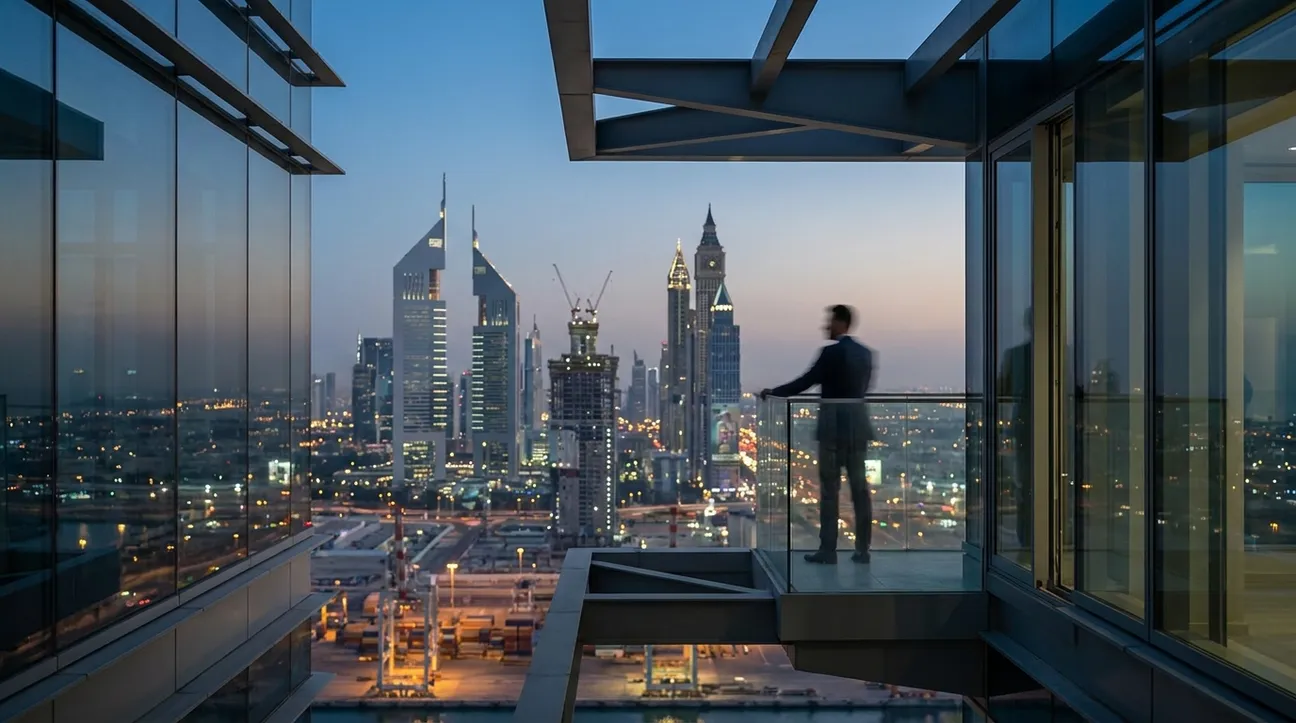
Dubai's ultra-luxury architects: how OMNIYAT, DAMAC Capital and global deal-makers are reshaping the emirate's skyline
A $60 billion residential market in H1 2026 reveals the strategic calculus behind boutique developers, single-family offices and cross-border capital advisory in the Gulf's most competitive luxury corridor.
Executive Summary
Key Takeaways
- Dubai's residential market hit $60.3 billion in H1 2026, with 2,847 luxury transactions worth AED 35.3 billion in Q1 alone.
- OMNIYAT recorded $5.4 billion in 2025 sales, targeting AED 200 billion portfolio growth by 2030 through design-led development.
- DAMAC Capital leverages global brand partnerships (e.g., Oracle Red Bull Racing) to enhance real estate pricing power.
- Savills' $1.1 billion acquisition of Eastdil Secured signals the Gulf's rising importance in global real estate advisory.
- New 2026 AML-aligned payment mandates strengthen Dubai's appeal to compliance-focused institutional capital.
- UAE luxury residential is projected to reach $77.08 billion by 2031 at a 9.34% CAGR.
The strategic logic behind Dubai's ultra-luxury concentration
Dubai's residential market recorded sales values totalling AED 221.4 billion ($60.3 billion) in the first half of 2026, according to data from Cavendish Maxwell. Within that extraordinary volume, the luxury segment carved out a distinct identity: Q1 2026 alone produced 2,847 luxury transactions with a combined market value of AED 35.3 billion, as reported by Mavrix Properties. These figures confirm that high-end real estate in Dubai has moved well beyond cyclical exuberance. It now constitutes a structural pillar of the emirate's economic architecture, attracting a specific class of developers, capital allocators and advisory firms whose strategies merit close examination.
The competitive landscape at the apex of this market is defined by a small number of platforms that combine architectural ambition with sophisticated capital structures. Understanding their positioning, and the ecosystem of global advisory firms that surrounds them, is essential for any institutional investor or developer seeking to operate in the Gulf Cooperation Council.
Who are the principal architects of Dubai's boutique ultra-luxury pipeline?
Two platforms stand out for their scale, brand equity and strategic clarity: OMNIYAT and DAMAC Capital.
Mahdi Amjad, Founder and Executive Chairman of OMNIYAT, has built one of the most recognisable ultra-luxury development brands in the Middle East. The company recorded total sales of $5.4 billion in 2025, according to Forbes. OMNIYAT targets an AED 200 billion portfolio growth by 2030, as tracked by the MENA Intelligence Desk, a trajectory that would make it one of the largest design-led real estate platforms in the region. Amjad's approach centres on commissioning signature architecture from globally recognised studios, curating tenant and buyer profiles with precision, and maintaining tight control over the entire value chain from land acquisition through asset management. The result is a portfolio that functions simultaneously as real estate and as a luxury brand, with each project reinforcing the platform's market positioning.
DAMAC Capital, the single-family office of Hussain Sajwani founded in 1982, operates with a different strategic model. While DAMAC Properties remains one of Dubai's largest volume developers, DAMAC Capital represents the family's direct investment vehicle, with reach extending well beyond real estate into global brand partnerships. In 2026, DAMAC Capital signed a global partnership with Oracle Red Bull Racing, signalling an intent to position the platform at the intersection of ultra-high-net-worth lifestyle, sport and real estate. This cross-sector brand strategy reflects a broader trend among Gulf-based family offices: the deliberate construction of global lifestyle ecosystems that enhance the desirability and pricing power of their core real estate assets.
These two platforms illustrate the dual logic of Dubai's ultra-luxury market. OMNIYAT pursues architectural distinction and portfolio scale within the emirate. DAMAC Capital leverages global brand affiliation to elevate the perceived value of its developments. Both approaches depend on Dubai's regulatory environment, its position as a capital destination, and the continued inflow of international wealth.
How is cross-border capital advisory evolving in the Gulf's luxury corridor?
The sophistication of Dubai's ultra-luxury development market has attracted a parallel infrastructure of global capital advisory. Eastdil Secured, one of the most prominent real estate investment banking platforms in the world, maintains an active international office in the Dubai International Financial Centre, as registered with the Dubai Financial Services Authority. The firm's presence in the DIFC reflects the growing complexity of deal structures in the Gulf, where cross-border capital flows, multi-jurisdictional ownership structures and increasingly institutional buyer profiles demand advisory capabilities that match those available in New York or London.
Eastdil Secured's own corporate trajectory underscores the value that global platforms assign to real estate advisory with Gulf exposure. In March 2026, Savills plc signed a definitive agreement to acquire Eastdil Secured for an enterprise value of $1.1125 billion. That valuation, for an advisory firm rather than a principal investor, signals the premium that institutional markets place on relationships and transaction expertise in high-growth real estate corridors. Dubai's luxury market, with its combination of sovereign wealth, family office capital and ultra-high-net-worth private buyers, represents precisely the kind of environment where advisory firms can command significant fee income.
For GRI Institute members active in cross-border real estate investment, the Eastdil Secured acquisition by Savills illustrates a broader structural shift. Global advisory platforms are consolidating to offer end-to-end services across geographies, and the Gulf is a primary driver of that consolidation. The advisory infrastructure available in Dubai today rivals any global financial centre, a development that would have been difficult to anticipate a decade ago.
What regulatory shifts are shaping the ultra-luxury market's trajectory?
Dubai's regulatory framework continues to evolve in ways that directly affect ultra-luxury development and capital flows. Two measures enacted in 2026 deserve particular attention.
Law No. (4) of 2026 regulates the occupancy and management of shared housing in the Emirate of Dubai, requiring permits and defining maximum occupancy per square foot. While this legislation primarily targets the mid-market and workforce housing segments, its indirect effect on ultra-luxury is significant. By tightening standards in shared accommodation, Dubai reinforces the qualitative differentiation of its premium residential stock, ensuring that luxury developments operate within a regulatory context that protects brand value and neighbourhood character.
The 2026 Direct Payment Mandate issued by the Dubai Land Department requires all property sale proceeds to be transferred directly into a UAE-based bank account in the name of the individual or individuals listed on the Title Deed, restricting third-party Power of Attorney accounts to comply with anti-money laundering standards. This regulation addresses a longstanding concern among institutional investors and compliance-focused buyers about transparency in Gulf property transactions. For ultra-luxury developers, the mandate provides a competitive advantage: it aligns Dubai's transactional infrastructure with international AML expectations, making the market more accessible to regulated institutional capital and family offices operating under strict compliance frameworks.
Together, these measures reflect Dubai's strategic intent to position itself as a mature, transparent luxury real estate market rather than a speculative frontier. Developers like OMNIYAT and platforms like DAMAC Capital benefit directly from this regulatory trajectory, as it attracts precisely the buyer profile they target.
The global logistics dimension: a counterpoint worth noting
Any analysis of the Gulf's real estate landscape must acknowledge that the region's significance extends well beyond luxury residential. Stuart Gibson, Co-Founder and Co-CEO of ESR Group, represents a different but equally consequential dimension of real estate strategy in the broader Asia-Pacific and Gulf corridor. ESR Group operates as a major logistics real estate platform, and while Gibson's work sits outside the boutique ultra-luxury development category, his presence in the wider GRI Institute ecosystem underscores the diversity of capital and expertise flowing through the region. Logistics real estate and luxury residential may occupy different market segments, but they share a dependence on the same macroeconomic drivers: sovereign investment, regulatory stability, infrastructure connectivity and the strategic positioning of Gulf states as global nodes of commerce and capital.
Market outlook and strategic implications
The UAE luxury residential real estate market is projected to grow at a CAGR of 9.34%, reaching USD 77.08 billion by 2031, according to Mordor Intelligence. That growth trajectory, if sustained, will intensify competition among boutique developers, accelerate the professionalisation of capital advisory services, and place greater pressure on regulatory frameworks to maintain transparency and investor confidence.
Dubai completed 24,800 new homes in the first half of 2026, according to Cavendish Maxwell. The critical question for the ultra-luxury segment is whether supply discipline can be maintained as the broader market expands. Developers like OMNIYAT have historically managed supply with precision, limiting unit counts to preserve exclusivity and pricing power. Whether that discipline holds as the market scales will determine the segment's long-term performance.
For GRI Institute members, the strategic takeaway is clear. Dubai's ultra-luxury market has matured into an institutionally relevant asset class with its own ecosystem of developers, advisors and regulators. The platforms leading this market, from OMNIYAT's design-led approach to DAMAC Capital's global brand strategy to Eastdil Secured's advisory capabilities in the DIFC, represent distinct but complementary models of value creation. Engaging with this ecosystem requires understanding each model's strategic logic, regulatory context, and capital structure.
The conversations that shape this market increasingly take place within senior leadership networks like those convened by GRI Institute, where developers, investors and advisors exchange perspectives in a confidential, relationship-driven format. As the Gulf's luxury corridor continues to attract global capital, the quality of those conversations will determine which platforms capture disproportionate value in the cycle ahead.