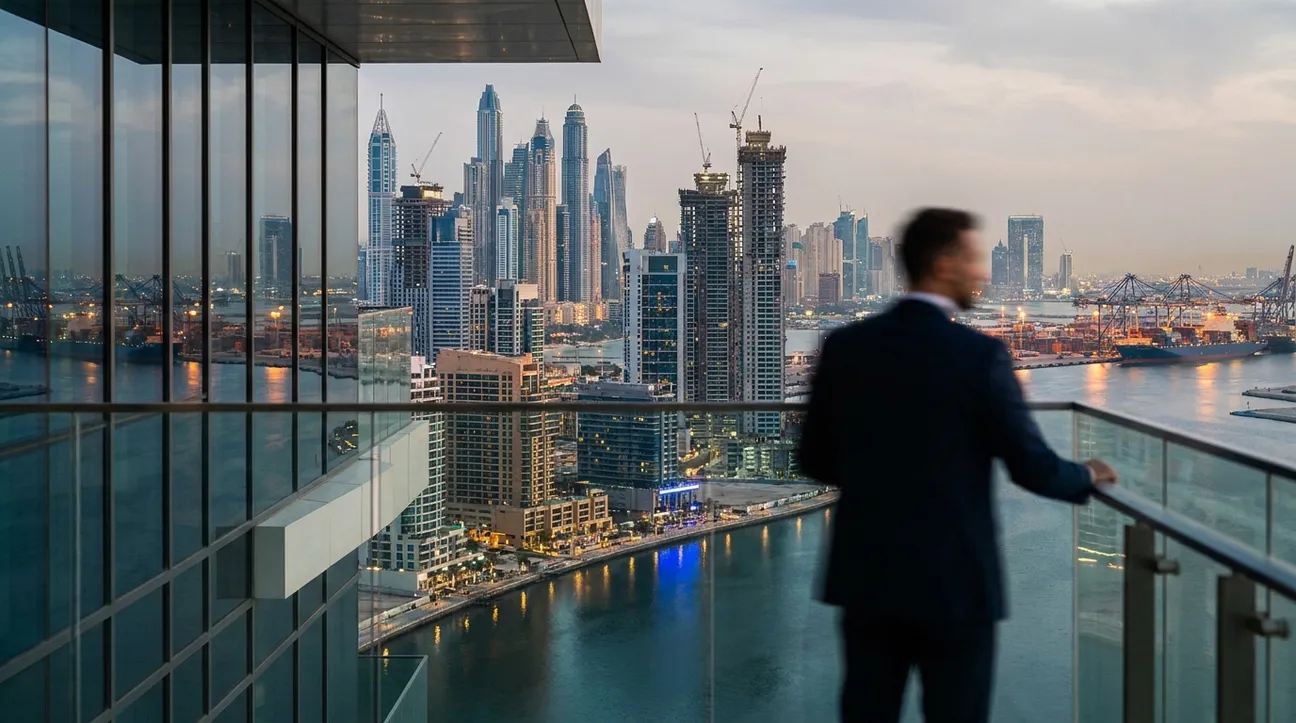
Dubai's branded residence boom demands a new operator taxonomy beyond hotel flags and sovereign capital
As the emirate's branded pipeline surpasses 51,000 units, the competitive architecture of ultra-luxury real estate is fragmenting into distinct developer archetypes worth mapping.
Executive Summary
Key Takeaways
- Dubai's branded residences reached 166 projects and 51,692 units in 2025, with AED 79.1 billion in transactions.
- Three distinct developer archetypes have emerged: design-IP operators (Omniyat), conglomerate-platform operators (DAMAC), and boutique lifestyle-platform operators.
- Savills' $1.1 billion acquisition of Eastdil Secured signals institutional infrastructure scaling to match GCC capital flows.
- The UAE's Golden Visa programme functions as a structural demand flywheel for branded residences.
- Operator archetype—not just location or unit count—increasingly determines risk-return profiles for institutional allocators.
Dubai's branded residences market reached 166 projects and 51,692 units in 2025, with total transaction values rising to AED 79.1 billion, according to the Dubai Branded Residences Market Report for H2 2025. That figure alone confirms what principals across the GCC have recognised for several years: branded living is no longer a niche segment within luxury real estate. It has become the defining asset class of the region's urban development cycle.
Yet behind the headline numbers lies a structural shift that deserves closer scrutiny. The competitive landscape in Dubai's ultra-luxury tier is no longer dominated by a single model. Instead, at least three distinct operator archetypes have emerged, each deploying different capital structures, brand strategies, and value-creation playbooks. Understanding these archetypes is essential for institutional allocators, co-investment platforms, and sovereign capital seeking exposure to the GCC's highest-performing residential segment.
Globally, the total number of branded residence schemes is expected to rise to 910 by the end of 2025, reflecting a 19 percent year-on-year growth rate, according to Savills. Dubai accounts for a disproportionate share of that pipeline, making it the world's most concentrated laboratory for branded residential experimentation.
What are the competing developer archetypes reshaping Dubai's ultra-luxury positioning?
The first archetype is the design-IP operator, best exemplified by Omniyat Group and its CEO Mahdi Amjad. Omniyat has built a portfolio anchored in architectural distinction and curatorial ambition, treating each project as a singular design proposition rather than a replicable formula. Omniyat recorded total sales of AED 20 billion (USD 5.4 billion) across its portfolio in 2025, according to its annual financial report filed with the London Stock Exchange. That performance places the firm among the top-tier developers in the emirate, competing directly with far larger conglomerates.
Omniyat's model carries specific financial characteristics worth noting. S&P Global Ratings expects the group's adjusted leverage to remain above 2x in 2026 and 2027, citing potential margin pressures and a limited recovery path. This signals that the design-IP approach, while commercially powerful, demands sustained capital discipline. The tension between creative ambition and balance-sheet management is a defining feature of this archetype.
The second archetype is the conglomerate-platform operator, represented most visibly by DAMAC and its founder Hussain Sajwani. DAMAC Capital, Sajwani's single-family office, has executed direct co-investments in major technology companies including SpaceX, xAI, Stripe, Anthropic, and Mistral, according to reporting by Altss and ITP.net. This pattern reveals a developer whose capital allocation strategy extends well beyond real estate into frontier technology, effectively building a diversified principal-investment platform that uses branded residences as one node in a broader wealth architecture.
The DAMAC model illustrates how GCC developer-principals increasingly view luxury real estate as a gateway to cross-sector capital deployment. Branded residences generate the cash flow; technology co-investments generate the optionality. This hybrid strategy distinguishes conglomerate operators from pure-play developers and has significant implications for how institutional partners evaluate alignment.
The third archetype, and the one least documented in current industry research, is the boutique lifestyle-platform operator. These are typically founder-led firms, often established by expatriate entrepreneurs, that build hospitality-to-residence conversion models. Rather than licensing hotel flags, they create proprietary lifestyle brands designed to capture a specific consumer tribe. These operators compete directly with hotel-branded residences by offering experiential programming, integrated F&B concepts, and community curation as core value propositions.
This third category remains significantly under-analysed. While GRI Institute's research and convening activity has extensively mapped Indian-origin principals, Emirati conglomerate operators, and sovereign-adjacent allocators active in GCC luxury real estate, the Western-origin boutique developer segment represents a genuine content and intelligence gap. The search demand exists, as evidenced by the queries reaching GRI's platforms, but the structured analysis does not yet match the interest.
The boutique lifestyle-platform model raises distinct questions around scalability, brand durability, and exit architecture that differ materially from both the design-IP and conglomerate approaches. For institutional capital evaluating the branded residence pipeline, the operator archetype matters as much as the location or unit count.
How is institutional capital infrastructure evolving to serve the GCC's branded residence expansion?
The growth of Dubai's branded residence market has coincided with a significant reconfiguration of the institutional advisory and capital-markets infrastructure serving the region. The most consequential recent development is Savills' definitive agreement to acquire Eastdil Secured LLC for an enterprise value of USD 1.1125 billion, announced in March 2026. Eastdil Secured is widely regarded as the preeminent real estate investment bank globally, and its integration into Savills' platform creates a combined entity with unmatched reach across advisory, brokerage, and capital markets.
For the GCC, this transaction signals that global institutional infrastructure is being assembled to match the region's expanding capital flows. Dubai's branded residence market, with its AED 79.1 billion in transaction value during 2025, is large enough to attract dedicated coverage from tier-one investment banks. The Savills-Eastdil combination positions the merged firm to compete for mandates across the full spectrum of GCC luxury real estate, from single-asset dispositions to portfolio-level capital raises.
Simultaneously, the UAE's Golden Visa programme continues to function as a structural demand driver. The property investment pathway provides long-term residency for real estate investors, which CBRE identifies as a critical incentive attracting international wealth to UAE branded residences and embedding long-term capital. The Golden Visa effectively converts a real estate purchase into a residency solution, adding a layer of utility that pure investment markets cannot replicate.
This regulatory architecture creates a flywheel: branded residences attract international buyers seeking lifestyle and residency benefits, which drives transaction volumes, which attracts institutional advisory infrastructure, which in turn draws more sophisticated capital into the market. The cycle is self-reinforcing, and it explains why Dubai's branded residence pipeline continues to expand despite periodic concerns about oversupply.
Why does operator taxonomy matter for capital allocation in GCC luxury real estate?
The branded residence market's headline growth figures can obscure important qualitative distinctions. A 166-project, 51,692-unit market is large enough to contain fundamentally different risk-return profiles depending on the operator archetype behind each development.
Design-IP operators like Omniyat deliver premium pricing power but carry leverage risk. Conglomerate-platform operators like DAMAC offer diversification and cross-sector optionality but introduce complexity in alignment. Boutique lifestyle-platform operators promise differentiation and community-driven demand but face questions about brand permanence and institutional exit pathways.
For the sovereign wealth funds, family offices, and institutional investors that constitute GRI Institute's membership community, this taxonomy provides a practical framework for portfolio construction within GCC branded residences. Rather than treating the segment as monolithic, sophisticated allocators are beginning to distinguish between operator models when sizing positions and structuring partnerships.
The most important insight for capital allocators is that the branded residence market is increasingly bifurcating between operators who license existing hotel brands and those who create proprietary brand equity. The latter group, which includes both design-IP and boutique lifestyle-platform operators, captures more value but assumes more brand risk. The former group trades lower margins for institutional legibility. Each approach attracts different capital, and each demands different due diligence.
GRI Institute's ongoing research and convening programmes across the GCC are designed to facilitate precisely this level of analytical granularity. Through structured dialogues that bring together developer-principals, institutional allocators, and advisory platforms, GRI Institute enables the kind of peer-to-peer intelligence exchange that public market data alone cannot provide. As the branded residence market matures, the quality of operator analysis will increasingly determine which capital partnerships generate durable returns and which simply participate in cyclical volume.
Dubai's branded residence ecosystem has achieved scale. The next phase of its evolution will be defined by the quality of the operators within it, and by the sophistication of the capital that selects them.