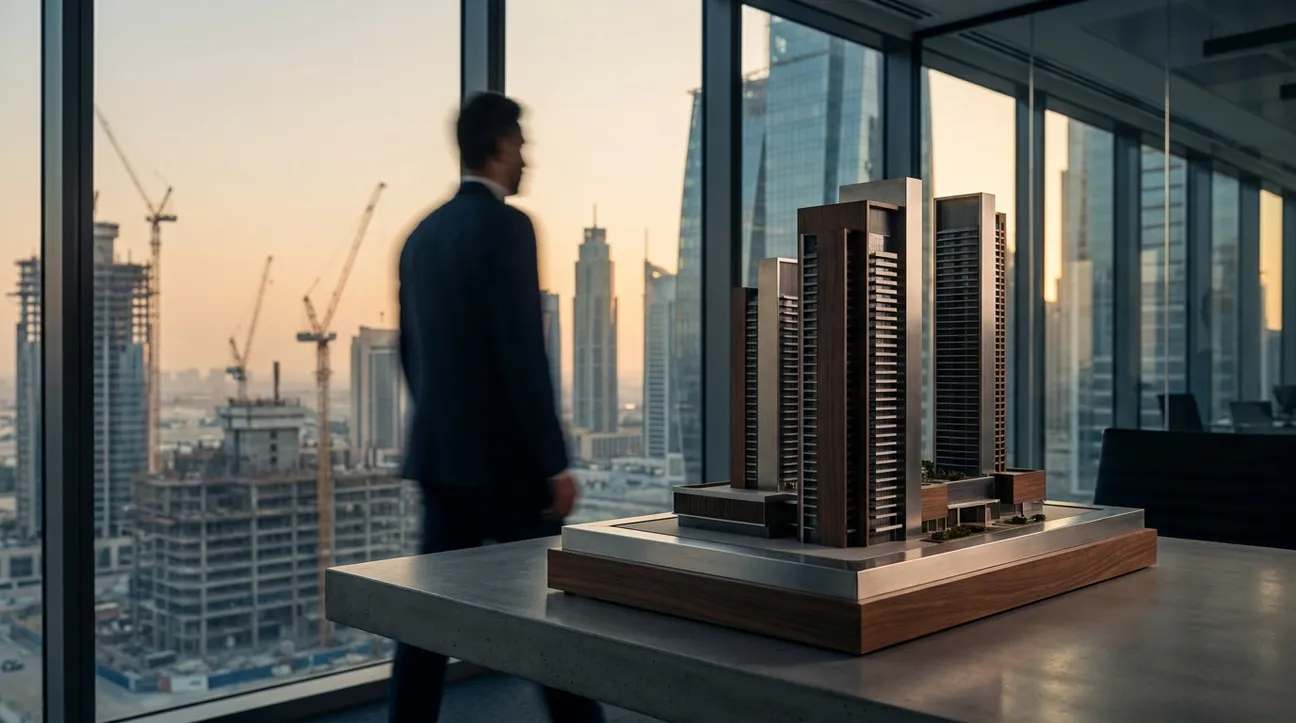
Design-led hospitality architects are engineering a new branded residence category across the GCC
As Dubai leads the global branded residences market with 151 completed and pipeline projects, a new archetype of hospitality-operator-turned-developer is reshaping luxury real estate conventions.
Executive Summary
Key Takeaways
- Dubai leads globally with 151 completed and pipeline branded residence projects, while MENA saw 187% growth in branded residences over five years.
- A new "hospitality-operator-turned-developer" archetype is emerging, integrating design philosophy, operations, and development into a single discipline.
- Design credibility is becoming a capital markets strategy, evidenced by Omniyat's 3x oversubscribed AED 2.2 billion Sukuk issuance.
- UAE regulatory modernisation, including the 2025 Civil Code and Dubai's shared housing law, supports integrated design-and-operations models.
- The branded residence market is shifting from volume growth to qualitative differentiation favoring specificity over scale.
The branded residence sector in the Gulf Cooperation Council has entered a phase of structural transformation. What began as a straightforward licensing arrangement between hotel flags and developers has evolved into a more complex ecosystem where design philosophy, operational expertise, and capital markets sophistication converge. Dubai, the undisputed global capital of branded living, now counts 64 completed branded residence projects and 87 in the pipeline, according to the Savills Branded Residences Report 2025/2026. The Middle East and North Africa region as a whole registered a 187% growth in branded residences over the past five years, a pace that demands scrutiny of the forces driving supply and the new categories of product emerging from it.
At the heart of this evolution lies a distinct archetype: the hospitality-operator-turned-developer. These are figures and firms whose origins sit in hotel design, curation, and guest experience, and who have migrated into real estate development with a conviction that buildings should be conceived as experiential platforms rather than mere containers for branded amenities. This archetype stands apart from both the traditional hotel-flag model, where a Four Seasons or Ritz-Carlton lends its name to a residential tower, and the lifestyle-brand licensing model, where fashion houses or automotive marques attach cachet to floor plates they will never manage. The hospitality-operator-turned-developer brings something neither of those models can deliver: an integrated vision where design intent and operational reality are conceived as a single discipline.
Why does the hospitality-operator-turned-developer archetype matter for the GCC's next cycle?
The GCC's luxury real estate market is approaching a maturity threshold. Dubai's luxury segment alone is projected to grow to $77.08 billion by 2031, according to GRI Hub News. At that scale, differentiation becomes the paramount challenge. Buyers in the ultra-prime segment, particularly the international high-net-worth individuals who constitute a growing share of Dubai's transaction base, are no longer satisfied with a prestigious logo on a lobby wall. They seek coherent environments where architecture, interior design, service programming, and community curation reflect a unified creative intelligence.
This is the gap that design-led hospitality operators fill. Their competitive advantage is not a brand licence but an integrated capability set: the ability to conceive a building's spatial logic, select its materials, programme its services, and manage its ongoing experience as a single creative act. In a market where Dubai recorded 87,800 real estate transactions worth AED 291.7 billion in the first half of 2026 alone, according to data cited by MERED and Gulf Today, the volume of capital seeking deployment demands that developers offer increasingly sophisticated propositions to capture attention and justify premium pricing.
The emergence of this archetype also reflects a broader institutional maturation in the region's capital markets. Savills' acquisition of global real estate investment bank Eastdil Secured for an enterprise value of $1.1125 billion, announced in March 2026, signals that the advisory and transaction infrastructure supporting GCC real estate is reaching new levels of sophistication. When institutional capital flows are facilitated by advisors of this calibre, the developers who attract that capital must demonstrate equally rigorous thinking about product, brand, and long-term asset value.
How are established GCC developers responding to the design-led challenge?
The region's most prominent developers have already begun to internalise the logic of design-led differentiation. Omniyat, founded by Mahdi Amjad, represents perhaps the clearest example of a developer that has built its identity around architectural ambition and design curation. Omniyat's trajectory offers instructive parallels. The firm aims to double its property portfolio to more than Dh200 billion ($54.4 billion) by 2030, according to The National. Its capacity to attract capital on favourable terms was demonstrated when it priced a AED 2.2 billion Sukuk at 7.25% for a five-year tenor, an issuance that was over three times oversubscribed, according to Propsearch.ae.
That oversubscription ratio is telling. It suggests that the capital markets reward developers whose brand proposition extends beyond location and specification into the realm of design identity and experiential promise. Mahdi Amjad has built Omniyat into a platform where collaboration with architects such as Zaha Hadid and Foster + Partners is central to the value proposition. The lesson for the broader market is clear: design leadership is not a marketing overlay but a capital markets strategy.
The competitive landscape is intensifying. DAMAC Capital and other well-capitalised GCC developers are scaling their branded residence pipelines aggressively. The total number of branded residence schemes worldwide is expected to reach 910 by the end of 2025, according to the Savills Branded Residences Report 2025/2026, and the GCC accounts for a disproportionate share of that pipeline. In this environment, the developers who command the highest premiums will be those who can articulate a distinctive design philosophy and translate it into operational excellence across the lifecycle of a building.
What regulatory and structural shifts are enabling this new category?
The UAE's regulatory environment is evolving in ways that support the growth of design-led, hospitality-inflected real estate. Federal Decree-Law No. 25 of 2025, the new Civil Code effective June 1, 2026, modernised the concept of sale to include digital and intangible asset transfers, a provision that has implications for the way branded residence agreements, intellectual property licences, and service contracts are structured. The same law lowered the legal age of majority from 21 to 18, expanding the pool of individuals who can legally own and sign for property in the UAE.
At the emirate level, Dubai's Law No. (4) of 2026 regulates the occupancy and management of shared housing, prohibiting the allocation of a real estate unit for shared housing without a permit. While primarily aimed at residential density management, this legislation also creates a clearer regulatory framework for the curated living environments that design-led developers seek to create, where the quality and character of a building's residential community are treated as integral to its value proposition.
These regulatory developments, combined with the depth of institutional capital now flowing into the region, create conditions where the hospitality-operator-turned-developer archetype can thrive. The model requires a regulatory environment that protects intellectual property, enforces service standards, and provides clarity on ownership structures, all areas where the UAE has made significant progress.
The strategic implications for investors and developers
The rise of the design-led hospitality developer carries several implications that GRI Institute members operating in the GCC should consider carefully.
First, the branded residence category is undergoing a segmentation that will reward specificity over scale. The 187% five-year growth rate in MENA branded residences, documented by Savills, cannot be sustained by hotel-flag licensing alone. The market demands new entrants with distinctive propositions, and the hospitality-operator-turned-developer archetype offers precisely that differentiation.
Second, capital allocation decisions in the ultra-luxury segment increasingly hinge on design credibility. The oversubscription of Omniyat's Sukuk issuance demonstrates that the debt markets recognise design-led developers as creditworthy counterparties. Equity investors are applying similar filters. The convergence of Savills' advisory capabilities, through its Eastdil Secured acquisition, with the branded residence sector it tracks so closely through its annual reports, illustrates how institutional infrastructure and product innovation are becoming mutually reinforcing.
Third, the regulatory evolution in the UAE is creating a framework where integrated design-and-operations models can be protected and scaled. Developers who treat design as a core competency rather than an outsourced function will find that the legal and regulatory environment increasingly supports their ambitions.
The branded residence market in the GCC stands at an inflection point where volume growth gives way to qualitative differentiation. The developers and operators who understand that buildings are arguments, that every material choice, spatial sequence, and service interaction makes a case for a particular way of living, will define the next phase of the region's luxury real estate market.
GRI Institute continues to convene the senior executives shaping this evolution through its GCC-focused events and research initiatives. The intersection of hospitality design, capital markets innovation, and regulatory modernisation represents one of the most consequential themes in the region's real estate landscape, and one that demands sustained analytical attention from the leaders who are building the GCC's future.