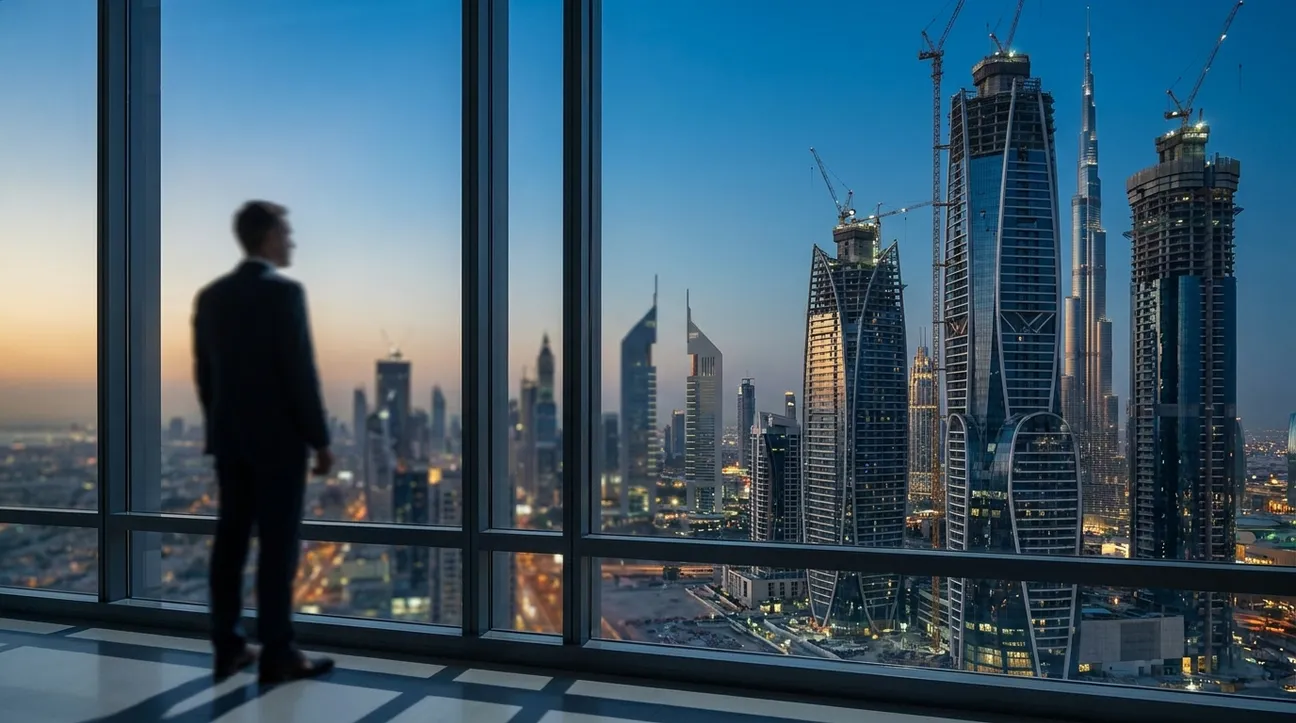
Design-driven developers are reshaping Dubai's ultra-luxury competitive landscape
With $9 billion in prime home sales in 2025 alone, Dubai's boutique developer ecosystem is attracting global capital and rewriting the rules of branded residences.
Executive Summary
Key Takeaways
- Dubai recorded 500+ home sales above $10M in 2025, totaling over $9B, making it the world's top ultra-luxury residential market.
- Design-driven, principal-led developers like OMNIYAT ($5.4B in 2025 sales) are outperforming volume-driven competitors by treating architecture as core strategy.
- Savills' ~$1.1B acquisition of Eastdil Secured, which has a DIFC office, signals institutional capital markets validation of Dubai.
- Branded residences will comprise 54% of new supply in Ras Al Khaimah by 2030, pushing differentiation toward authentic design and operational credibility.
- Dubai's 2026 Direct Payment Mandate strengthens AML compliance, reinforcing buyer confidence at the ultra-luxury tier.
The architect-developer model is defining Dubai's next ultra-luxury cycle
Dubai recorded 500 home sales worth more than $10 million in 2025, totaling over $9 billion in prime transactions, according to Knight Frank. That figure made the emirate the world's top market for ultra-luxury residential sales, surpassing London, New York, and Hong Kong in both volume and velocity. In the first half of 2026, the trajectory has only accelerated: 296 luxury home sales above $10 million were registered, representing a 14% year-on-year increase in value to $5.1 billion, according to Knight Frank data cited by Gulf News.
These numbers tell a structural story. Dubai's ultra-luxury segment is no longer an episodic phenomenon tied to oil-price cycles or expo-driven speculation. It has matured into a permanent asset class, underpinned by residency-linked investment, global wealth migration, and a regulatory framework that increasingly favors transparency. Within this ecosystem, a distinct breed of developer has emerged: the design-driven principal who treats architecture, curation, and brand identity as core competitive advantages rather than marketing afterthoughts.
The model is best exemplified by firms like OMNIYAT, founded by Mahdi Amjad, which recorded total sales of $5.4 billion in 2025. That figure comprised $2.5 billion for OMNIYAT-branded projects and $1.6 billion for its BEYOND brand, according to Forbes. OMNIYAT's approach, rooted in commissioning signature architects and delivering residences with distinct design narratives, has become a template that several boutique developers now seek to replicate across Dubai's waterfront and downtown corridors.
But the competitive landscape extends well beyond any single firm. A growing cohort of developer principals, many of them with backgrounds in hospitality, architecture, or global investment, are staking claims in the $10 million-plus segment. They share a conviction that ultra-high-net-worth buyers are acquiring design propositions as much as square footage, and that the developer's personal vision functions as a de facto brand.
Who are the developer principals competing for Dubai's ultra-luxury buyer?
The ultra-luxury tier in Dubai is characterized by a relatively small number of principal-led firms whose founders exert direct creative and strategic control over product development. This contrasts with the volume-driven model employed by larger developers, where scale and speed-to-market take precedence over architectural distinction.
Mahdi Amjad's OMNIYAT remains the most prominent example. The firm's strategy of partnering with architects such as Zaha Hadid Architects and Foster + Partners, combined with a curated approach to amenities and community programming, has positioned it as the benchmark for design-led luxury in the GCC. The $5.4 billion in 2025 sales, verified by Forbes, confirms that the market rewards this approach with pricing power and absorption rates that outperform broader market averages.
The Sajwani family's DAMAC Capital, the private investment arm of the Sajwani family office, operates in an adjacent but distinct space. Its 2026 global partnership with Oracle Red Bull Racing signals an intent to fuse lifestyle branding with real estate at a scale that transcends traditional property marketing. DAMAC Capital's strategy reflects a recognition that ultra-luxury buyers respond to cultural signifiers, and that partnerships with globally recognized brands can unlock buyer segments that purely architectural narratives cannot reach alone.
FIVE Holdings, formerly known as SKAI Holdings and founded by Kabir Mulchandani, represents yet another archetype: the hospitality-native developer. By integrating hotel-grade service delivery into residential product from inception, FIVE has carved a niche among buyers who prioritize operational experience and lifestyle programming alongside design quality.
These firms compete for the same finite pool of ultra-high-net-worth capital, yet each deploys a differentiated thesis. The result is a market where competitive intensity drives continuous product innovation, benefiting buyers and reinforcing Dubai's position as the world's most dynamic ultra-luxury residential market.
How is global capital infrastructure adapting to Dubai's ultra-luxury boom?
The maturation of Dubai's luxury segment has attracted not only developers and buyers but also the institutional advisory infrastructure that traditionally served New York, London, and Hong Kong. The most significant signal came in early 2026, when Savills completed its acquisition of Eastdil Secured for an enterprise value of approximately $1.1 billion, according to disclosures reviewed by Latham & Watkins. Eastdil Secured operates a Dubai DIFC office, positioning the combined entity to advise on capital markets transactions across the emirate's rapidly expanding prime sector.
The presence of firms like Eastdil Secured in DIFC reflects a broader institutional validation of Dubai as a permanent node in the global real estate capital markets network. For ultra-luxury developers, this translates into deeper access to cross-border equity, more sophisticated debt structures, and advisory relationships that connect Dubai product to sovereign wealth funds, family offices, and institutional allocators across Asia, Europe, and North America.
This capital markets maturation also coincides with regulatory evolution. The Dubai Land Department's 2026 Direct Payment Mandate now requires all property sale proceeds to be transferred directly into a UAE-based bank account in the name of the individual listed on the Title Deed, restricting third-party Power of Attorney accounts for anti-money-laundering compliance. The measure signals the emirate's commitment to aligning its real estate transaction infrastructure with global AML standards, a development that sophisticated buyers and their advisors increasingly view as a positive differentiator rather than a friction point.
For design-driven developers, the convergence of institutional advisory presence and regulatory transparency creates a more favorable environment for premium pricing. Buyers deploying $10 million or more into a single residential asset demand the same governance standards they encounter in institutional-grade investments. Dubai's regulatory trajectory is meeting that expectation.
What role do branded residences play in the region's competitive architecture?
The branded residence phenomenon, already well established in Dubai, is now expanding aggressively across the GCC. According to CBRE, branded residences will account for 54% of new residential supply in Ras Al Khaimah by 2030, with close to 9,000 units expected to be delivered. This projection underscores the degree to which the hotel-branded and designer-branded model has moved from niche to mainstream across the emirates.
Branded residences represent a convergence point for the various competitive strategies deployed by Dubai's ultra-luxury developers. For design-driven firms, the brand partnership provides a service and operational layer that complements architectural distinction. For hospitality-native developers, the branded model is a natural extension of their core competency. For capital-markets-oriented players, the brand premium delivers measurable yield enhancement: luxury apartments in the UAE are projected to generate rental returns of 5% to 8% in 2026, according to industry guides, with branded product typically commanding the upper end of that range.
The competitive implications are significant. As branded supply proliferates, differentiation will depend increasingly on the quality of the developer principal's vision, the authenticity of the design narrative, and the operational credibility of the brand partner. Developers who treat branding as a superficial label rather than an integrated design and service proposition risk commoditization in a segment defined by exclusivity.
GRI Institute's ongoing engagement with senior leaders across the GCC's luxury and hospitality sectors, through its conferences and closed-door gatherings, has consistently surfaced this tension between scale and curation. The most successful developer principals, according to perspectives shared within the GRI community, are those who maintain direct creative oversight while building organizations capable of institutional-grade execution.
The strategic horizon
Dubai's ultra-luxury market is entering a phase where competitive advantage accrues to developer principals who integrate design leadership, brand authenticity, and capital markets sophistication into a unified proposition. The $9 billion in prime sales recorded in 2025 and the 14% value increase in the first half of 2026 confirm that global wealth continues to flow toward the emirate's highest-quality residential product.
The arrival of global advisory platforms like Eastdil Secured, the tightening of AML-aligned transaction regulations, and the expansion of branded residences across the GCC all point toward a market that is professionalizing rapidly. For developer principals, this environment rewards vision, discipline, and the capacity to deliver design narratives that resonate with the world's most discerning buyers.
The firms and individuals who will define the next chapter of Dubai's ultra-luxury cycle are those who treat architecture as strategy, brand as substance, and regulatory compliance as competitive advantage. GRI Institute will continue to track this evolving landscape through its research, events, and direct engagement with the region's most influential real estate leaders.