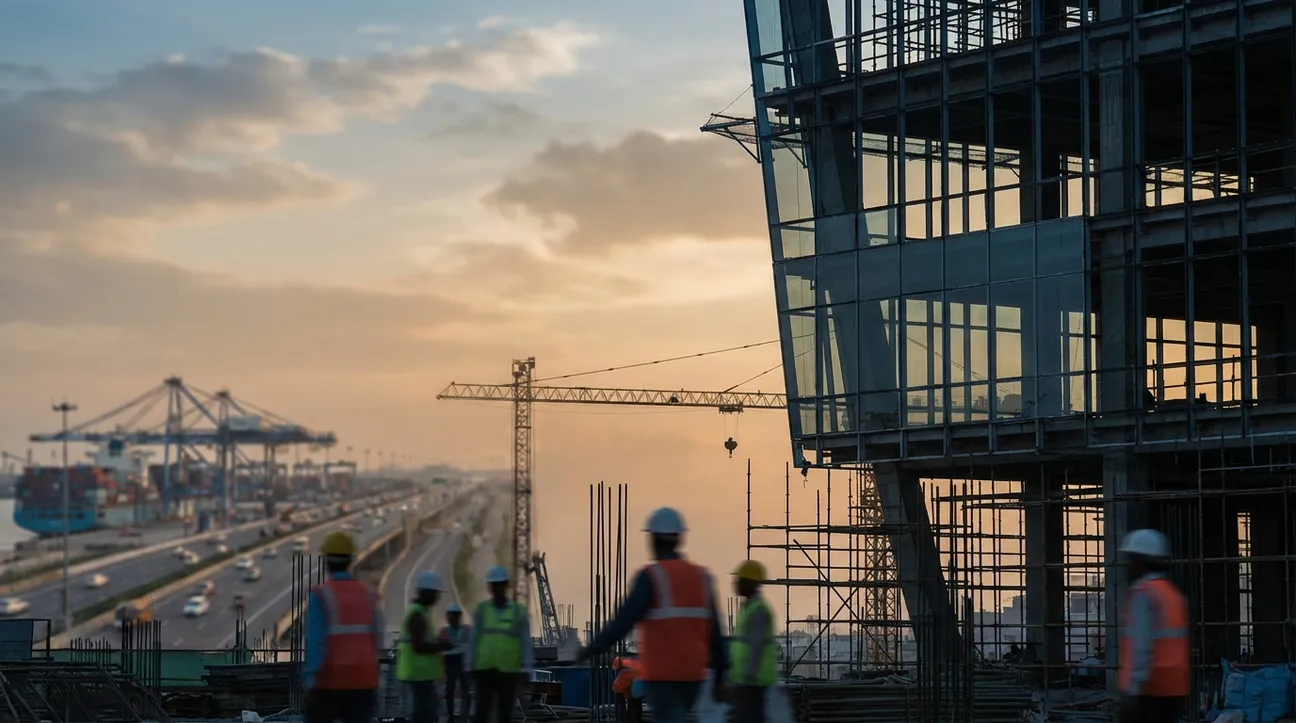
Christoph Schnellmann and the European institutional blueprint engineering India's next wave of real estate joint ventures
From Zurich Airport International's $1.2 billion greenfield bet to Godrej Fund Management's European-backed platforms, a new architecture of cross-border capital is reshaping Indian real estate.
Executive Summary
Key Takeaways
- Zurich Airport International's $1.2 billion Noida airport project exemplifies European patient capital driving Indian real estate value, with surrounding property prices surging 98% over five years.
- Godrej Fund Management raised $500 million with APG and Allianz for Grade A Indian office development, signaling platform-level European commitments over deal-by-deal investing.
- India's post-RERA regulatory framework has made the market significantly more compatible with European fiduciary and ESG mandates.
- Domestic institutional investors captured majority market share of Indian real estate investment in 2025 for the first time since 2014.
- India's real estate market is projected to reach $1 trillion by 2030.
European institutional capital is no longer circling India from a distance. It is landing, literally and figuratively, through infrastructure megaprojects and platform-level joint ventures that are redefining how global allocators access one of the world's fastest-growing real estate markets. At the centre of this shift stands a Swiss executive building an airport, and a constellation of fund managers structuring the vehicles that channel billions from Amsterdam, Munich, and Zurich into Indian offices, logistics parks, and mixed-use developments.
Christoph Schnellmann, CEO of Noida International Airport, leads the Rs 11,200 crore ($1.2 billion) greenfield project backed by Zurich Airport International AG, according to Business Standard. The airport, expected to welcome 6 million passengers in its first year of operation, is far more than a transport node. It is the single largest European-backed infrastructure catalyst in India's National Capital Region, and its ripple effects on surrounding real estate are already measurable. Average property prices in Greater Noida surged 98% over five years, reaching ₹6,600 per square foot in Q1 2025, according to Anarock. That price trajectory, anchored to a tangible infrastructure asset with Swiss operational governance, offers a case study in how European capital creates real estate value in India not through speculative bets, but through long-cycle infrastructure commitment.
This is the European institutional blueprint at work: deploy patient capital into physical infrastructure, accept long gestation periods in exchange for structural value creation, and let adjacent real estate markets reprice around the asset. Schnellmann's airport exemplifies a model that pension funds and insurance companies in Europe understand deeply, one built on regulated concessions, transparent governance, and multi-decade return horizons.
How are European institutions structuring platform-level partnerships with Indian fund managers?
The airport is one vector. The other, equally significant, is the emergence of dedicated fund platforms that pair European institutional limited partners with Indian general partners possessing local execution capability.
Godrej Fund Management raised $500 million for its GBTC II office development fund in partnership with APG Asset Management and Allianz Real Estate, two of Europe's largest institutional investors, according to RealtyNXT. This structure is instructive. Rather than making one-off co-investments or acquiring stabilised assets on a deal-by-deal basis, APG and Allianz committed capital to a development-stage vehicle managed by an Indian operator with deep land bank access, regulatory relationships, and construction expertise. The fund targets Grade A office development, a segment where India's supply-demand dynamics remain compelling as multinational corporations continue to expand their footprint in cities like Mumbai, Bengaluru, and Pune.
Godrej Fund Management's ambitions extend beyond commercial office. The firm signed a memorandum of understanding with the Government of Maharashtra to develop a film and media campus at Godrej City, Panvel, according to PR Newswire. This diversification into specialised mixed-use development signals that European-backed platforms are moving beyond vanilla asset classes into sectors where India's consumption economy and creative industries generate differentiated demand.
The platform model carries a strategic logic that separates it from earlier waves of foreign capital in Indian real estate. In the pre-RERA era, many global investors entered through opaque joint ventures with local developers, often suffering from governance failures, project delays, and capital misallocation. The Real Estate (Regulation and Development) Act, or RERA, has since institutionalised transparency, project-level escrow discipline, and regulatory accountability, materially reducing execution risks for global institutional capital. European allocators, with their fiduciary obligations and ESG mandates, find the post-RERA environment significantly more compatible with their deployment frameworks.
The $500 million GBTC II fund represents a structural evolution: European capital is entering India through institutional-grade vehicles with audited governance, clear exit timelines, and sector-specific mandates, rather than through ad hoc developer relationships.
Why does the 'Dubai plus India' allocation strategy matter for cross-border dealmakers?
Dr. Amit Goenka of Nisus Finance has articulated a thesis that resonates across GRI Institute's network of cross-border capital allocators. Global portfolios are increasingly adopting a 'Dubai plus India' allocation strategy, treating the two markets as complementary nodes in an emerging-market real estate allocation.
The logic is grounded in portfolio construction fundamentals. Dubai offers liquidity, regulatory simplicity, and exposure to Middle Eastern and African capital flows. India offers scale, demographic tailwinds, and a long runway of urbanisation-driven demand. Goenka has projected that India will need approximately 93 million additional urban homes by 2036, as urban residents constitute nearly 40% of the population, according to ET Edge Insights. That housing deficit alone represents a multi-decade investment opportunity that no single market in the Middle East or Southeast Asia can match in volume.
India's real estate market is projected to reach a $1 trillion valuation by 2030, according to GRI Hub News. For European institutions managing multi-billion-dollar portfolios with 20-year-plus liability profiles, the Indian market's trajectory toward that milestone creates a compelling case for early platform-level commitments. The question is no longer whether to allocate to India, but how to structure that allocation for maximum governance, scalability, and alignment with local operating partners.
The convergence of the Dubai and India thesis also reflects a geographic rebalancing in global real estate portfolios. European institutions that historically concentrated emerging-market exposure in Latin America or Central and Eastern Europe are diversifying toward South and West Asia, where demographic and urbanisation fundamentals are stronger. GRI Institute's events across India and the Gulf have become critical venues where these allocation conversations crystallise into actionable deal flow.
What structural shift is redefining who controls Indian real estate capital flows?
A less visible but equally consequential development is the rise of domestic institutional capital. According to JLL India data reported by GRI Hub News, domestic institutional investors captured the majority market share of Indian real estate investments in 2025, marking a structural shift in capital dominance for the first time since 2014.
This does not diminish the role of European capital. It reframes it. European institutions are no longer the dominant source of institutional capital in Indian real estate. They are one pillar in a multi-source capital structure that includes Indian insurance companies, pension funds, family offices, and domestic alternative investment funds. The competitive landscape for deal access has intensified, and European allocators who lack established platform partnerships risk being crowded out of the best opportunities.
This is precisely why the Godrej Fund Management model matters. By locking in European institutional capital through dedicated fund vehicles with multi-year deployment mandates, Indian fund managers create preferential access structures that bypass the increasingly competitive open-market deal flow. European LPs gain visibility into pipelines before assets reach the broader market. Indian GPs gain committed capital that enables them to move faster on land acquisitions and development approvals.
The Schnellmann-led airport project operates on a different but parallel logic. Zurich Airport International's concession structure grants it operational control over a generational infrastructure asset, insulating it from the competitive dynamics that characterise equity-stage real estate investment. The airport's value creation accrues through passenger throughput, commercial revenues, and the appreciation of surrounding land, a combination that European infrastructure funds find highly attractive.
For GRI Institute members active in India's real estate and infrastructure markets, the strategic implications are clear. The next wave of European-Indian joint ventures will be defined by platform-level commitments, not deal-by-deal opportunism. The operators and fund managers who build these platforms first will control the capital architecture for the decade ahead.
The convergence of Schnellmann's infrastructure blueprint, Godrej Fund Management's institutional fund structures, and the broader shift toward domestic capital dominance creates a market environment where execution capability, governance standards, and relationship depth determine which partnerships succeed. European institutions bring patient capital and fiduciary discipline. Indian operators bring local knowledge, regulatory navigation, and access to a real estate market on a trajectory toward $1 trillion. The architecture connecting these two sides is where the real value lies, and it is being built now.
GRI Institute continues to serve as the convening platform where these cross-border dealmakers meet, exchange intelligence, and structure the partnerships that shape India's real estate future. The conversations happening at GRI India events, from office and logistics forums to infrastructure-focused gatherings, are the proving ground for the next generation of European-Indian capital alliances.