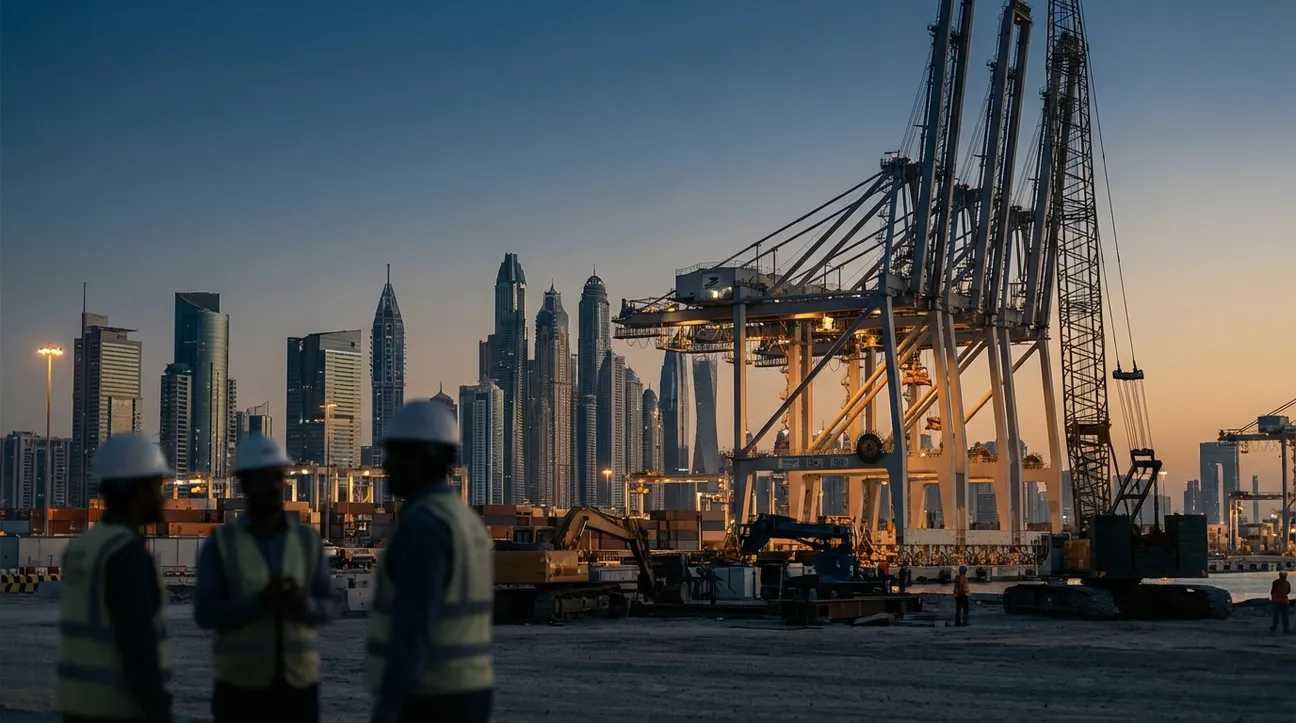
China Harbour Engineering Company amasses $3.8 billion in Saudi contracts, reshaping GCC development
CHEC's expanding footprint across Diriyah, Roshn and Abu Dhabi signals a structural shift in how Chinese state enterprises enter Gulf real estate markets.
Executive Summary
Key Takeaways
- CHEC has secured over $3.8 billion in Saudi contracts since 2023 across Roshn, Diriyah, and other Vision 2030 giga-projects.
- A 200,000 sqm modular factory in Riyadh signals a shift from transactional contracting to industrial embedding in the real estate supply chain.
- CHEC's model creates long-term dependencies with sovereign developers rather than pursuing direct equity ownership.
- Evolving GCC regulations, including Saudi Arabia's draft Foreign Real Estate Ownership Law, could eventually enable Chinese state enterprises to transition from contractors to asset owners.
- Local and regional contractors face growing competitive pressure from vertically integrated, state-backed Chinese firms.
A $3.8 billion contract footprint in three years
China Harbour Engineering Company (CHEC), the flagship subsidiary of China Communications Construction Company (CCCC), has accumulated over $3.8 billion in confirmed construction contracts across Saudi Arabia's most prominent giga-projects since 2023. The figure, compiled by GRI Institute from publicly disclosed awards, positions CHEC as one of the largest single foreign contractors operating within the Kingdom's Vision 2030 pipeline and raises a critical question for the region's real estate sector: what happens when infrastructure-scale contractors begin building the industrial foundations that make residential and mixed-use development possible?
The data trail is concrete. In September 2023, Roshn, the residential development arm of the Public Investment Fund (PIF), awarded CHEC a $2.1 billion (SAR 7.7 billion) contract to develop 6,700 residential units and amenities in the Sedra and Warefa communities, according to Zawya and MEED. In December 2024, Diriyah Company awarded CHEC a $202.2 million (SAR 758.5 million) contract for bulk excavation works in Diriyah's second phase, as disclosed by Diriyah Company. Then in July 2025, CHEC secured a $1.53 billion (SAR 5.75 billion) contract to build the Diriyah Arena Superblock, according to Diriyah Company and Goalfore Advisory.
These are not peripheral assignments. They sit at the core of Saudi Arabia's most capital-intensive urban transformation programmes.
How is CHEC converting infrastructure contracts into real estate positioning?
The conventional narrative around Chinese state-owned enterprises in the Gulf frames their role as pure contractors: they bid, they build, they leave. CHEC's trajectory in Saudi Arabia challenges that reading. The company is embedding itself in the real estate value chain through industrial capacity, not equity acquisition.
In February 2025, CHEC opened a 200,000 square metre modular building factory in Riyadh, designed to supply prefabricated components for Roshn's Sedra housing project, according to China Daily and Xinhua. The factory represents a deliberate shift from transactional contracting to structural participation. By localising manufacturing capacity, CHEC creates a recurring supply relationship with Saudi developers that extends well beyond any single project's timeline.
This approach distinguishes CHEC from some of its Chinese state-owned peers that have pursued direct equity stakes in Gulf real estate assets. CHEC's conversion is structural rather than financial: the company is building the industrial base, the physical foundations and the prefabricated components that make large-scale residential delivery feasible. The modular factory in Riyadh, for instance, directly supports the delivery of thousands of housing units at a time when Saudi Arabia's National Housing Company targets delivering 300,000 housing units by 2025, according to the National Housing Company and Zawya.
For GRI Institute members tracking Sino-Gulf capital flows, this industrial embedding model warrants close attention. It creates dependencies and partnerships that persist across project cycles.
CCCC's broader strategic pivot toward asset-light international operations
CHEC's Gulf expansion operates within a broader corporate strategy at the parent level. Chinese state-owned enterprises, including CCCC, are shifting from capital-intensive domestic real estate development to asset-light international infrastructure and industrial services, according to CCCC and Shanghai Metals Market. The timeframe for this transition extends through 2025 to 2030.
The implications for the GCC are significant. Rather than Chinese capital arriving as equity investment in residential towers or hospitality assets, it arrives as construction capacity, manufacturing infrastructure and technical expertise. This model carries lower financial risk for the Chinese side while generating deeper operational ties with Gulf sovereign developers.
In Abu Dhabi, CHEC is constructing office and utility buildings at Khalifa Port as part of a concession agreement, according to Global Construction Review. The port project illustrates the company's ability to operate across the infrastructure-to-commercial spectrum, from heavy marine engineering to building-level delivery within a single economic zone.
What regulatory frameworks enable Chinese state enterprises to operate in GCC real estate?
The legal architecture supporting foreign participation in Gulf development has evolved considerably. In Saudi Arabia, the Private Sector Participation Law (Royal Decree No. M/63), enacted in 2021 with ongoing regulatory updates, provides the framework for public-private partnerships and allows foreign investors to participate in and own stakes in project companies for infrastructure and public services. This legislation underpins the contractual structures through which entities like CHEC operate on PIF-linked projects.
A draft Foreign Real Estate Ownership Law, expected for enactment in 2025 or 2026, would allow non-resident foreigners and legal entities to own real estate in Saudi Arabia, excluding Makkah and Madinah. If enacted, this legislation would significantly broaden the market for international developers and could shift the calculus for Chinese state enterprises currently operating as contractors rather than equity participants.
In the UAE, Federal Decree-Law No. 12 of 2023, effective from December 1, 2023, regulates public-private partnerships and encourages private sector participation, including foreign entities, in strategic federal projects. This framework complements Abu Dhabi's existing concession model, under which CHEC operates at Khalifa Port.
The regulatory trajectory across the GCC points toward greater foreign participation rights. For Chinese state enterprises already deeply embedded as contractors, these evolving frameworks could eventually facilitate a shift from industrial presence to equity ownership.
The super-contractor model and its implications for Gulf developers
CHEC's role in the GCC is best understood as that of a super-contractor with industrial integration capabilities. The company does not merely execute construction; it imports manufacturing infrastructure, localises production and creates multi-project supply chains. The Riyadh modular factory is the clearest expression of this model.
This has direct consequences for Gulf developers and sovereign wealth fund subsidiaries. Entities like Roshn and Diriyah Company gain access to scaled delivery capacity at a time when the region faces well-documented constraints in construction labour, material supply and project execution timelines. In return, CHEC secures long-term commercial relationships with some of the region's most capitalised development entities.
The model also raises questions about competitive dynamics. As Chinese state enterprises embed deeper into Saudi Arabia's construction ecosystem, local and regional contractors face a competitor with access to state-backed financing, vertically integrated supply chains and a strategic mandate to expand internationally.
Industry leaders who have discussed these dynamics at GRI Institute gatherings consistently note that the scale of Vision 2030 commitments requires international contractor participation. The question is whether that participation remains at the contractor level or migrates toward development equity over time.
Mapping the pipeline: where CHEC operates across the GCC
Based on publicly confirmed awards and disclosures, CHEC's active GCC portfolio spans three distinct project categories:
Large-scale residential delivery. The $2.1 billion Roshn contract covers 6,700 units across the Sedra and Warefa communities, supported by the Riyadh modular factory.
Giga-project infrastructure and superstructure. The Diriyah portfolio now exceeds $1.7 billion across two contracts, covering bulk excavation and the Arena Superblock.
Port and industrial zone development. The Khalifa Port concession in Abu Dhabi positions CHEC within the UAE's logistics and industrial corridor.
This portfolio concentration in Saudi Arabia reflects the Kingdom's outsized share of regional construction spending and PIF's role as the dominant commissioning entity. For business inquiries related to PIF projects, the fund's Riyadh office serves as the primary point of contact, with specific project inquiries typically routed through subsidiaries such as Roshn or Diriyah Company.
What to watch
Three developments will determine whether CHEC's Gulf presence remains contractual or evolves into something more structural. First, the enactment timeline and final provisions of Saudi Arabia's Foreign Real Estate Ownership Law will signal whether non-resident entities can transition from building assets to owning them. Second, the performance of the Riyadh modular factory will test whether localised manufacturing delivers the cost and speed advantages that justify the investment. Third, the broader CCCC strategy of asset-light international expansion will shape how aggressively the parent company pursues equity positions versus service contracts.
GRI Institute will continue to track these developments as part of its ongoing coverage of cross-border capital flows into GCC real estate and infrastructure. The Sino-Gulf development corridor is no longer a future trend. It is a present reality measured in billions of dollars of committed contracts.