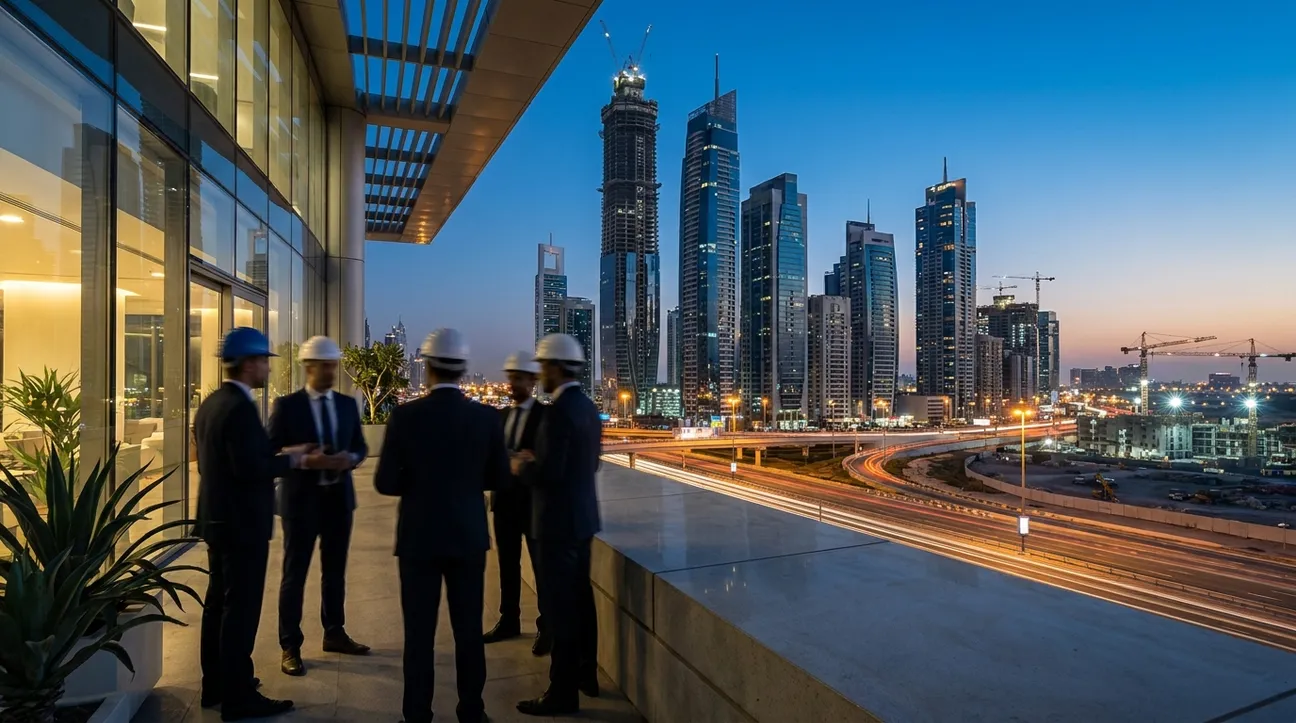
Beyond mega-developers: how boutique capital and institutional intermediation are reshaping Dubai's ultra-luxury identity
From OMNIYAT's $5.4 billion sales record to Eastdil Secured's $1.1 billion acquisition, the GCC's luxury real estate ecosystem is maturing faster than its skyline.
Executive Summary
Key Takeaways
- OMNIYAT's $5.4B in 2025 sales proves boutique developers can achieve institutional-scale revenue through design differentiation and brand equity.
- Savills' $1.1B acquisition of Eastdil Secured signals the GCC's capital markets infrastructure has reached global institutional standards.
- Dubai recorded 296 home sales above $10M in H1 2026, totaling $5.1B, reflecting curation-driven demand.
- Dubai's AML-aligned payment mandates favor transparent, compliance-ready developers over speculative entrants.
- The UAE luxury residential market is projected to reach $77.08B by 2031 at a 9.34% CAGR.
Dubai's ultra-luxury residential market has entered a phase that defies its own mythology. For two decades, the city's identity was inseparable from the mega-developer model, where state-backed entities delivered scale at speed and marketed aspiration by the square kilometer. That model still commands enormous volume. According to W Capital Real Estate Brokerage and Arabian Business, Dubai's property market recorded approximately AED 286.4 billion ($78 billion) in property sales during the first half of 2026 alone. Yet within that vast pool of transactions, a more refined current is gathering force, one driven by boutique developers, institutional capital intermediaries, and design-led philosophies that treat architecture as a differentiator rather than a commodity.
The numbers at the top end tell the story most clearly. Knight Frank data reported by Gulf News shows that Dubai recorded 296 home sales worth more than $10 million in the first half of 2026, totaling $5.1 billion. These are transactions shaped by curation, not volume. They reflect the preferences of ultra-high-net-worth buyers who select residences the way they select art: for provenance, exclusivity, and the reputation of the creator behind the work.
Who is defining the boutique ultra-luxury segment in Dubai?
The most visible name in this space remains Mahdi Amjad, the founder of OMNIYAT, whose firm recorded total sales of $5.4 billion in 2025, according to Forbes Lists. OMNIYAT has built its brand around collaboration with signature architects and designers, treating each project as a standalone cultural statement rather than a unit in a portfolio. Amjad's model demonstrates that a developer without the land banks or sovereign backing of a mega-developer can still achieve institutional scale in revenue, provided it controls positioning, brand equity, and the end-to-end client experience.
OMNIYAT's success has inspired a broader ecosystem of boutique operators who compete on design density, limited inventory, and bespoke service. The competitive positioning within Dubai's ultra-luxury segment increasingly rewards developers who can articulate a coherent architectural vision and attract the kind of global talent, from Zaha Hadid Architects to Foster + Partners, that signals creative seriousness to international buyers.
Meanwhile, figures like Stuart Gibson, co-founder and co-CEO of ESR Group, represent a different but equally significant current in the Gulf's evolving capital landscape. ESR Group operates as a major logistics real estate platform, a sector that sits far from branded residences and waterfront penthouses. Yet Gibson's presence in the region underscores a critical truth: the diversity of institutional capital flowing through the Gulf is itself reshaping how all asset classes, including ultra-luxury residential, are financed, structured, and governed. The professional infrastructure that supports logistics-scale capital deployment creates spillover effects across the real estate spectrum, raising governance expectations and attracting a more sophisticated investor base.
The ultra-luxury segment's maturation is therefore a story with two protagonists. On one side, design-led developers like OMNIYAT define the product. On the other, institutional capital platforms and advisory firms define the financial architecture that makes complex cross-border deals possible.
How is institutional capital advisory transforming the GCC's real estate ecosystem?
The most telling data point of 2026 may not be a property transaction at all. In March, Savills plc signed a definitive agreement to acquire Eastdil Secured for an enterprise value of $1.1125 billion. Eastdil Secured maintains an active office in the Dubai International Financial Centre (DIFC) and has become one of the principal intermediaries connecting institutional capital with Gulf real estate opportunities.
The premium Savills paid reflects a structural shift. The GCC is no longer a market that simply attracts capital; it is becoming a market that professionally intermediates it. This distinction matters enormously. When a global advisory firm values its Gulf-facing capabilities at over a billion dollars, it signals that the region's capital markets infrastructure has reached a level of sophistication that institutional investors require before committing at scale.
For boutique ultra-luxury developers, this maturation of capital advisory creates new opportunities and new pressures simultaneously. On the opportunity side, access to Eastdil Secured's institutional relationships means that a developer like OMNIYAT can structure joint ventures, club deals, and forward-funded developments with sovereign wealth funds, family offices, and pension allocators who would not have considered Dubai a decade ago. On the pressure side, these same institutional counterparties demand transparency, governance standards, and exit strategies that boutique developers historically did not need to provide.
Dubai's 2026 anti-money laundering aligned payment mandates reinforce this trajectory. The new regulations, designed to strengthen the emirate's appeal to compliance-focused institutional capital, create an operating environment where developers must demonstrate not only aesthetic excellence but also financial probity. The regulatory tightening is welcomed by serious operators who view compliance as a competitive moat rather than a bureaucratic burden.
What does the growth trajectory mean for Dubai's architectural identity?
The UAE luxury residential market is projected to reach $77.08 billion by 2031, growing at a 9.34% CAGR, according to data compiled by GRI Hub News. The broader GCC real estate market is projected to grow from $141.2 billion in 2025 to $260.3 billion by 2034. These projections, if realized, imply that the current wave of boutique ultra-luxury development is in its early stages rather than approaching saturation.
Dubai's architectural identity is therefore being written in real time. The mega-developer model delivered the Palm Jumeirah, the Burj Khalifa, and the infrastructure that made Dubai legible to the global imagination. The boutique model is now layering a second identity on top: one defined by restraint, material quality, and design authorship. The coexistence of both models is the distinctive feature of this market moment.
The tension between these two approaches produces what is arguably Dubai's most productive creative friction. Mega-developers provide the urban fabric, the master-planned communities, and the transportation corridors. Boutique developers provide the singular buildings that anchor neighborhoods and command premium pricing. Neither model succeeds without the other.
Investors and developers who participate in GRI Institute's Gulf-focused gatherings consistently identify this duality as the market's defining strategic question. The conversations within the GRI Institute community reflect a consensus that Dubai's next chapter will be defined by the quality of collaboration between these two models rather than the dominance of either one.
Three observations emerge from this analysis that deserve consideration by every capital allocator and developer active in the Gulf.
First, brand equity in ultra-luxury real estate is now a balance-sheet asset. OMNIYAT's $5.4 billion in 2025 sales demonstrates that a developer's design reputation can generate revenue at a scale previously associated only with state-backed entities. The implication for new entrants is clear: architectural differentiation is a prerequisite for competing in this segment, not an optional enhancement.
Second, the institutionalization of capital advisory in the Gulf, symbolized by Eastdil Secured's $1.1 billion valuation and its DIFC presence, means that the region's real estate markets will increasingly be priced, structured, and governed according to global institutional standards. Developers who cannot meet those standards will find themselves excluded from the most attractive capital sources.
Third, the regulatory environment is evolving in favor of transparency. Dubai's AML-aligned payment mandates signal that the emirate is prioritizing long-term institutional credibility over short-term transactional convenience. For boutique developers, this is an unambiguous positive: compliance infrastructure separates serious operators from speculative entrants.
The boutique ultra-luxury model is rewriting Dubai's architectural identity one project at a time. Figures like Mahdi Amjad have demonstrated that design conviction, paired with commercial discipline, can create a new category within a market long defined by scale. The institutional capital infrastructure now arriving in the Gulf, from advisory platforms like Eastdil Secured to the regulatory frameworks that support them, provides the financial architecture this category needs to grow.
Dubai's skyline has always been a statement of ambition. The emerging question, one that GRI Institute's research and convening activities continue to explore, is whether that ambition will increasingly be expressed through architectural singularity rather than sheer height. The evidence from the first half of 2026 suggests the answer is yes.
GRI Institute remains committed to tracking these shifts through its research programs and leadership gatherings across the GCC, providing members with the strategic intelligence required to navigate a market that rewards precision over scale.