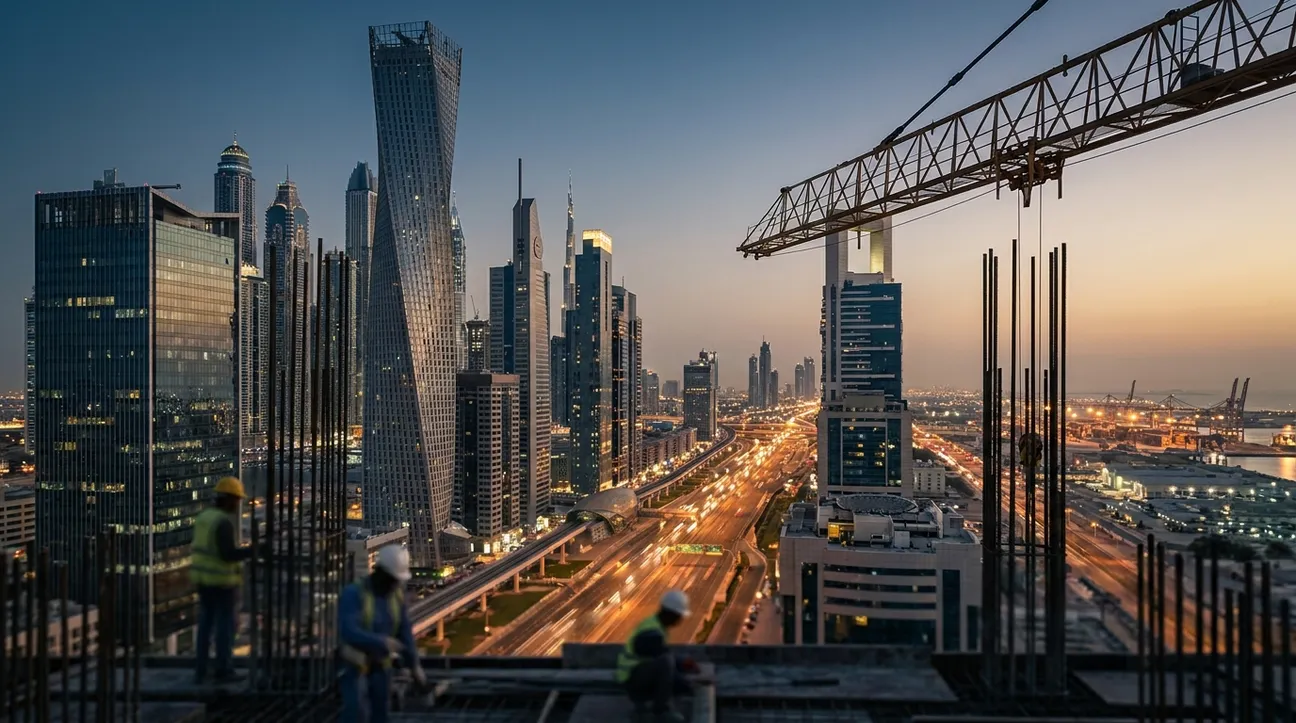
Boutique developers, institutional capital, and the architecture of Dubai's next luxury real estate cycle
As ultra-luxury transactions surge and global investment banks establish Dubai footholds, a new class of developer is reshaping the emirate's premium property landscape.
Executive Summary
Key Takeaways
- Dubai recorded 87,800 transactions worth AED 291.7 billion in H1 2026, with off-plan properties comprising 71% of deals and average prices up 9%.
- Ultra-luxury sales ($10M+) hit 500 transactions and $9.05 billion in 2025, rewarding developers offering scarcity and architectural distinction.
- Boutique developers are emerging as a new asset class, combining design-led value creation with institutional-grade capital structures.
- Savills' $1.1 billion acquisition of Eastdil Secured signals Dubai's permanence in global cross-border real estate capital flows.
- Family offices increasingly favor co-investment with specialist boutique developers over large-scale fund commitments.
Dubai's luxury real estate market has entered a structurally different phase. The emirate recorded 87,800 transactions worth AED 291.7 billion during the first half of 2026, with off-plan properties accounting for 71% of all deals, according to analysis by MERED published in Gulf Today. Average property prices rose 9% in the same period. These figures suggest a market that has moved beyond cyclical recovery into sustained expansion, driven by deepening capital pools, evolving buyer demographics, and a developer ecosystem that is growing more sophisticated by the quarter.
Within this expansion, a critical fault line is emerging between mega-developers and a rising cohort of boutique operators. The latter group, often led by principals with cross-border capital markets experience, is engineering a different product and a different investor proposition. Their approach combines architectural distinction, curated community positioning, and institutional-grade capital structures. This model is increasingly relevant to the global real estate investment community, and it is attracting attention from sovereign wealth allocators, family offices, and international advisory firms alike.
What is driving the structural shift in Dubai's luxury development model?
The traditional Dubai development playbook centered on scale, speed to market, and brand partnerships with hospitality operators. That model delivered enormous volumes and defined the city's skyline. It also created a product landscape where differentiation often resided in the logo on the building rather than in the architecture, spatial planning, or community design.
The new cycle operates on different economics. Dubai recorded 500 transactions for homes priced above $10 million in 2025, generating $9.05 billion in ultra-luxury sales value, according to Knight Frank's Q4 2025 Residential Market Review. Buyers at this price point are not purchasing square metres. They are purchasing exclusivity, design provenance, and long-term value preservation. This demand profile rewards developers who can deliver limited-edition residential products with genuine architectural merit.
Boutique developers occupy this precise niche. Their projects tend to feature lower unit counts, higher specification levels, and direct involvement of the founding principal in design decisions. The development model is capital-intensive on a per-unit basis but generates premium pricing power that compensates for smaller scale. In a market where ultra-luxury transactions alone exceeded $9 billion in a single year, the commercial logic is compelling.
The UAE luxury residential real estate market is projected to grow at a compound annual growth rate of 9.34%, reaching USD 77.08 billion by 2031, according to Mordor Intelligence. That trajectory creates space for multiple developer archetypes to coexist, but it particularly favours operators who can consistently deliver at the top of the pricing curve.
How are global capital structures reshaping Dubai's developer landscape?
The institutional infrastructure supporting Dubai's real estate market has matured significantly. One of the most consequential developments in 2026 was Savills plc's agreement to acquire global real estate investment bank Eastdil Secured LLC for an enterprise value of $1,112.5 million. Eastdil Secured maintains a Dubai office, and the acquisition by Savills signals that global advisory firms view the emirate as a permanent node in cross-border real estate capital flows, not a cyclical opportunity.
This matters for boutique developers because institutional capital requires institutional counterparts. Developers who can present auditable financial structures, transparent governance, and professional asset management capabilities gain access to capital sources that were previously reserved for listed REITs or sovereign-backed entities. The arrival of firms like Eastdil Secured in Dubai, and their subsequent absorption into global platforms like Savills, compresses the gap between boutique scale and institutional credibility.
Simultaneously, family office capital is becoming more visible and more strategic in the Dubai market. DAMAC Capital, the family office established by Hussain Sajwani, signed a global partnership with Oracle Red Bull Racing in 2026, according to reporting by Altss. While the partnership is primarily a branding exercise, it illustrates how family office vehicles are deploying capital across asset classes and geographies with increasing sophistication. DAMAC Capital's evolution from a development-focused family office to a diversified investment platform reflects a broader trend among GCC principal investors.
For boutique developers, this family office ecosystem represents both competition and opportunity. Family offices seeking direct real estate exposure often prefer co-investment structures with specialist developers over large-scale fund commitments. The boutique model, with its emphasis on principal alignment, project-level transparency, and design-led value creation, maps naturally onto family office investment preferences.
Why does the boutique developer model matter for the broader GCC investment thesis?
The GCC real estate investment thesis has historically been dominated by scale. Large master-planned communities, giga-projects in Saudi Arabia, and hospitality-driven mixed-use developments across the Gulf have absorbed the majority of capital and attention. These projects are essential to the region's economic diversification strategies, and they will continue to attract sovereign and institutional capital.
The boutique development model offers something complementary. It provides a pathway for design-driven value creation that does not depend on government-backed infrastructure commitments or tourism volume projections. Boutique developers generate returns through pricing power derived from scarcity, architectural quality, and location specificity. Their risk profile is fundamentally different from mega-project developers, and this difference creates portfolio diversification benefits for investors with existing GCC real estate exposure.
The model also addresses a growing demand from ultra-high-net-worth individuals for residential products that reflect personal identity rather than institutional branding. The 500 ultra-luxury transactions recorded in Dubai in 2025 represent buyers who increasingly seek properties designed by identified architects, developed by principals with visible creative involvement, and located in buildings with limited unit counts. This buyer profile is expanding as Dubai continues to attract wealth migration from Europe, South Asia, and the broader Middle East.
Boutique developers who combine this design sensibility with capital markets discipline represent a new asset class within GCC real estate. They are small enough to maintain creative control and large enough to deliver institutional-quality reporting and governance. The principals behind these firms tend to bring cross-border experience, often spanning capital markets, hospitality management, and design practice. Their operational model integrates functions that are typically separated in larger development organisations.
This integration creates execution risk, as single-principal models are inherently dependent on individual capacity and judgement. It also creates a distinctive competitive advantage. Buyers at the ultra-luxury level value the direct relationship with a founding principal who controls design, construction quality, and community curation. In a market increasingly defined by branded residences and hotel-affiliated developments, the independent boutique operator offers a genuine alternative.
The capital markets dimension
The convergence of boutique development models and institutional capital structures is creating new transaction formats in the Dubai market. Joint ventures between boutique developers and family offices are becoming more frequent. Development-stage equity commitments from regional high-net-worth investors are complementing traditional bank financing. And the presence of global advisory firms like Eastdil Secured, now part of the Savills platform, provides execution capability for cross-border capital seeking Dubai luxury exposure.
This capital markets maturation benefits the entire Dubai ecosystem, but it particularly rewards developers who can articulate a clear investment thesis at the project level. Boutique operators, with their limited portfolios and high per-unit values, can present granular underwriting that resonates with sophisticated investors. The ability to model individual unit sales, construction cost sensitivity, and exit timing at a level of detail that mega-project developers cannot replicate constitutes a structural advantage in capital raising.
GRI Institute's engagement with senior decision-makers across the GCC real estate landscape provides visibility into these evolving capital structures. Conversations at GRI Institute gatherings consistently highlight the growing appetite among institutional and family office investors for differentiated real estate products that combine design excellence with financial transparency. The boutique developer model sits at the intersection of these preferences.
Strategic implications for the GCC real estate market
Dubai's luxury real estate market is transitioning from volume-driven growth to value-driven maturation. The data confirms this trajectory. Average prices are rising, ultra-luxury transaction volumes are substantial, and the institutional advisory infrastructure is deepening. Within this environment, boutique developers occupy a strategically important position.
Their success or failure will signal whether the Dubai market can sustain premium pricing across a diversified developer ecosystem, or whether value creation remains concentrated in the largest operators. For investors, the boutique segment offers exposure to a differentiated risk-return profile. For the market as a whole, it offers evidence of deepening sophistication.
The principals driving this segment combine creative ambition with capital markets fluency. Their projects are small in scale but significant in market signal. As Dubai's luxury cycle matures, these boutique operators will increasingly define the quality ceiling against which the entire market is measured.
The GCC real estate investment community, as represented within the GRI Institute network, is watching this evolution closely. The questions now centre on execution, scalability, and capital access. The answers will shape the next decade of luxury development across the Gulf.