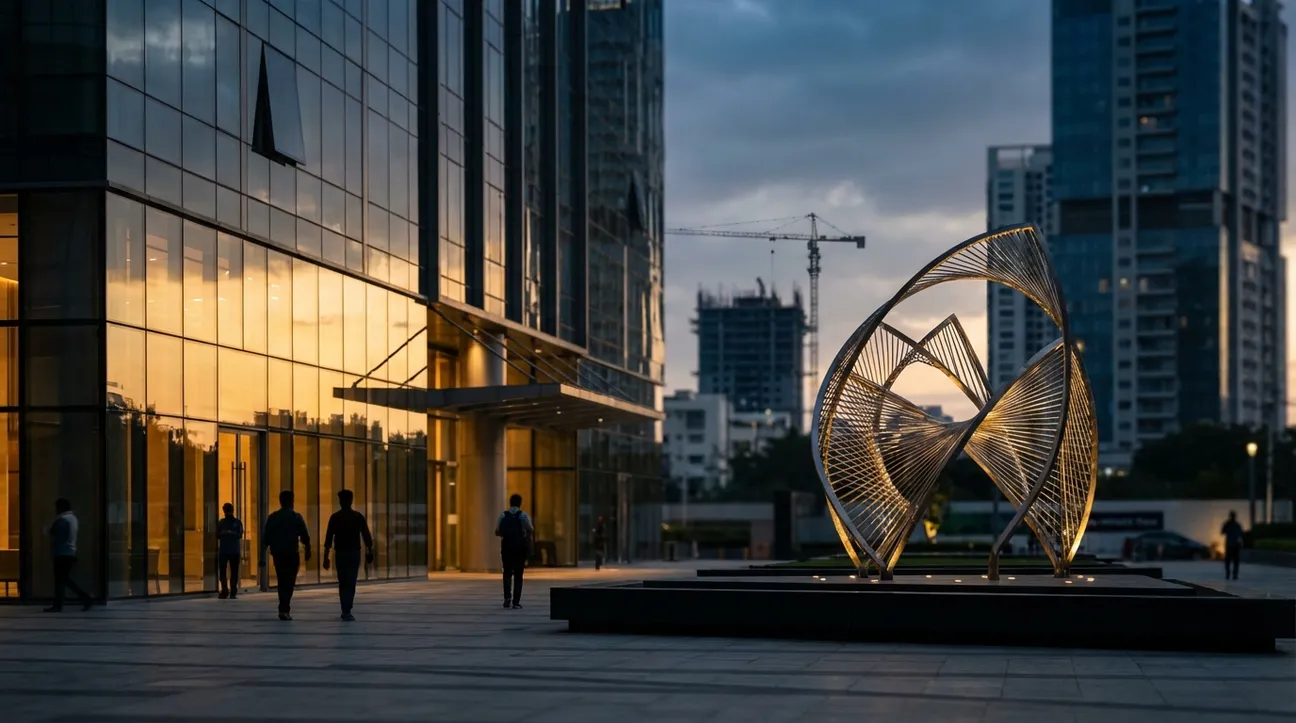
Bangalore's placemaking economy: how cultural infrastructure is reshaping India's top institutional market
From art weekends to arts-anchored developments, experiential real estate is emerging as a valuation driver across Bangalore's commercial and mixed-use sectors.
Executive Summary
Key Takeaways
- Cultural infrastructure is becoming a measurable valuation driver in Indian commercial and mixed-use real estate, not just a branding exercise.
- India's commercial real estate market is projected to grow from $49.31 billion in 2025 to over $123 billion by 2030.
- India's REIT ecosystem has surpassed Rs 1,00,000 crore market capitalization, creating structural incentives for experiential, institutionally compliant assets.
- Bangalore Art Weekend's 4,500+ RSVPs at full capacity signal reliable, scalable demand for culturally anchored experiences.
- SEBI's SM REITs Framework enables fractional ownership, opening regulated capital pathways for smaller experiential properties.
- Developers embedding cultural programming gain competitive advantages in tenant attraction, rental growth, and institutional capital access.
Over 4,500 RSVPs and every session at full capacity across nine venues: the 2025 edition of Bangalore Art Weekend delivered a clear signal that cultural programming has become a serious demand generator in India's most institutionally mature real estate market. Organized by Usual Suspects in partnership with GRI Institute, the event demonstrated the growing convergence between arts infrastructure and capital formation in a city that already anchors a disproportionate share of India's commercial real estate pipeline.
The numbers reflect a broader structural shift. India's commercial real estate market is projected to reach $49.31 billion in 2025 and exceed $123 billion by 2030, according to Mordor Intelligence and Construction Week India. Within that trajectory, Bangalore occupies a singular position: the city combines deep institutional ownership, a maturing REIT ecosystem, and a consumer base whose spending patterns increasingly reward experiential environments over conventional retail or office formats.
Why is cultural infrastructure becoming a valuation lever in Indian real estate?
For decades, Indian developers competed primarily on location, floor-space index, and price per square foot. That model is giving way to a performance-led framework in which footfall quality, tenant mix, and community engagement determine asset value. Cultural infrastructure, including gallery spaces, arts programming, curated public realms, and design-forward placemaking, sits at the centre of this transition.
Globally, institutional developers such as Brookfield, Lendlease, and Tishman Speyer have long deployed cultural anchors to drive leasing premiums, reduce vacancy, and strengthen ESG and community metrics. In India, a cohort of developers is now applying similar strategies with local specificity.
Pavitra Shankar, Managing Director of Brigade Group, is driving the company's ESG journey towards achieving net zero emissions by 2045, utilizing placemaking and customer experience to command premium valuations, according to GRI Institute and ET Edge. Brigade's approach illustrates a conscious integration of sustainability commitments with experiential design, a combination that institutional investors increasingly require when underwriting mixed-use assets.
Nitesh Shetty, Founder and Chairman of Nitesh Land, has pivoted the company to focus exclusively on commercial and rental luxury real estate, emphasizing "Quality, Culture, Brand, and Service" in developments like Nitesh Madison Square, according to Nitesh Land. The explicit inclusion of culture as a strategic pillar signals that experiential differentiation is no longer a peripheral amenity but a core component of asset-level positioning.
Placemaking-driven strategies are also reaching adjacent segments. Adarsh Narahari, Founder and MD of Primus Senior Living, sold 120 luxury senior living flats for over Rs 180 crore in just two weeks at the Primus Darpan project in South Bengaluru, according to Construction Week India. While senior living operates under distinct demand drivers, the velocity of absorption suggests that curated lifestyle environments, anchored in community experience and design quality, command accelerated conversion across asset classes.
How does the REIT ecosystem amplify the case for experiential assets?
India's Real Estate Investment Trust sector surpassed a Rs 1,00,000 crore market capitalization milestone, according to India Brand Equity Foundation (IBEF). That scale creates a structural incentive for developers to build institutionally compliant assets that generate predictable, premium rental income. Cultural infrastructure and experiential programming contribute directly to this objective by increasing tenant retention, attracting higher-quality occupiers, and differentiating assets in competitive micro-markets.
SEBI's SM REITs Framework, introduced in 2024, further deepens the institutional infrastructure by enabling fractional ownership of rent-generating real estate assets under a regulated investment vehicle. The framework improves investor protection and transparency for commercial and mixed-use assets, creating a regulated pathway for smaller experiential and culturally anchored properties to access institutional capital.
The retail REIT category in India is expected to grow to Rs 60,000 to 80,000 crore by 2030, according to Anarock. Experiential retail, the segment most directly influenced by placemaking and cultural programming, stands to capture a meaningful share of that growth as investors seek assets with defensible footfall and superior net operating income trajectories.
The convergence is clear: as REITs demand higher-quality underlying assets, developers who invest in experiential differentiation position themselves to access cheaper capital, achieve faster lease-up, and command valuation premiums at exit.
The Bangalore Art Weekend signal
Bangalore Art Weekend has evolved from a niche cultural gathering into a data point that real estate strategists should monitor. The 2025 edition, with its 4,500-plus RSVPs and full-capacity sessions across more than nine venues, according to Usual Suspects and GRI Institute, demonstrates that Bangalore's consumer base actively seeks culturally anchored experiences, and that this demand can be reliably aggregated at scale.
For developers, the implications are direct. Arts events and cultural programming generate measurable footfall in specific locations, create media visibility that reinforces neighbourhood branding, and attract a demographic profile, typically high-income, design-conscious, and community-oriented, that aligns precisely with the tenant and buyer profiles targeted by premium mixed-use and commercial assets.
Institutional developers in other global markets have formalized this relationship. Cultural programming is underwritten as part of asset management budgets, with gallery partnerships, public art installations, and seasonal events treated as operating expenditures that drive top-line performance. In Bangalore, the transition from ad hoc sponsorship to strategic integration is underway, and developers who move early will establish defensible brand equity in the city's most competitive corridors.
What does India's $1 trillion real estate trajectory mean for experiential assets?
The Indian real estate industry is expected to reach US$ 1 trillion by 2030 and contribute 13% to the country's GDP by 2025, according to IBEF. Within that expansion, the allocation of capital towards experiential and culturally anchored assets is poised to accelerate for three reasons.
First, regulatory maturation through frameworks like RERA and the SM REITs structure creates the transparency and governance standards that institutional investors require. RERA, active since 2016, has matured to support institutional capital entry into experiential and mixed-use developments by streamlining disclosure and protecting consumer interests.
Second, the growing sophistication of India's developer cohort means that placemaking is increasingly treated as a quantifiable investment rather than an intangible amenity. Leaders across Bangalore's development landscape are building organizational capabilities around design, community engagement, and cultural curation that mirror global institutional best practices.
Third, consumer demand in India's top cities has shifted decisively. The velocity of premium absorption, the capacity utilization of cultural events, and the willingness of buyers to pay for lifestyle-integrated environments all point toward a market that rewards experiential depth.
Developers who embed cultural infrastructure into their asset strategies are not pursuing a soft branding exercise. They are building measurable competitive advantages in tenant attraction, rental growth, and institutional capital access.
The institutional thesis takes shape
Bangalore's position as India's leading institutional real estate market is well established. What the placemaking and cultural economy layer adds is a new dimension of value creation that aligns developer strategy with investor requirements and consumer preferences simultaneously.
The data points converge: a commercial market on track to exceed $123 billion by 2030, a REIT ecosystem that has crossed Rs 1,00,000 crore in market capitalization, a retail REIT category projected to reach Rs 60,000 to 80,000 crore within the same timeframe, and a cultural event ecosystem that consistently demonstrates capacity-level demand.
For institutional investors evaluating Indian real estate allocations, the placemaking dimension introduces a qualitative edge that translates into quantitative performance. Assets anchored by cultural programming and experiential design generate stronger occupancy, higher rental trajectories, and more resilient valuations through market cycles.
GRI Institute continues to convene leaders at the intersection of capital, development, and cultural strategy through platforms including Bangalore Art Weekend and its global club events. As the experiential layer of Indian real estate matures, the dialogue between developers, investors, and cultural practitioners will shape which markets and which assets capture the next wave of institutional capital.
Bangalore, with its unique combination of institutional depth, consumer sophistication, and cultural vitality, is positioned to lead that transition.