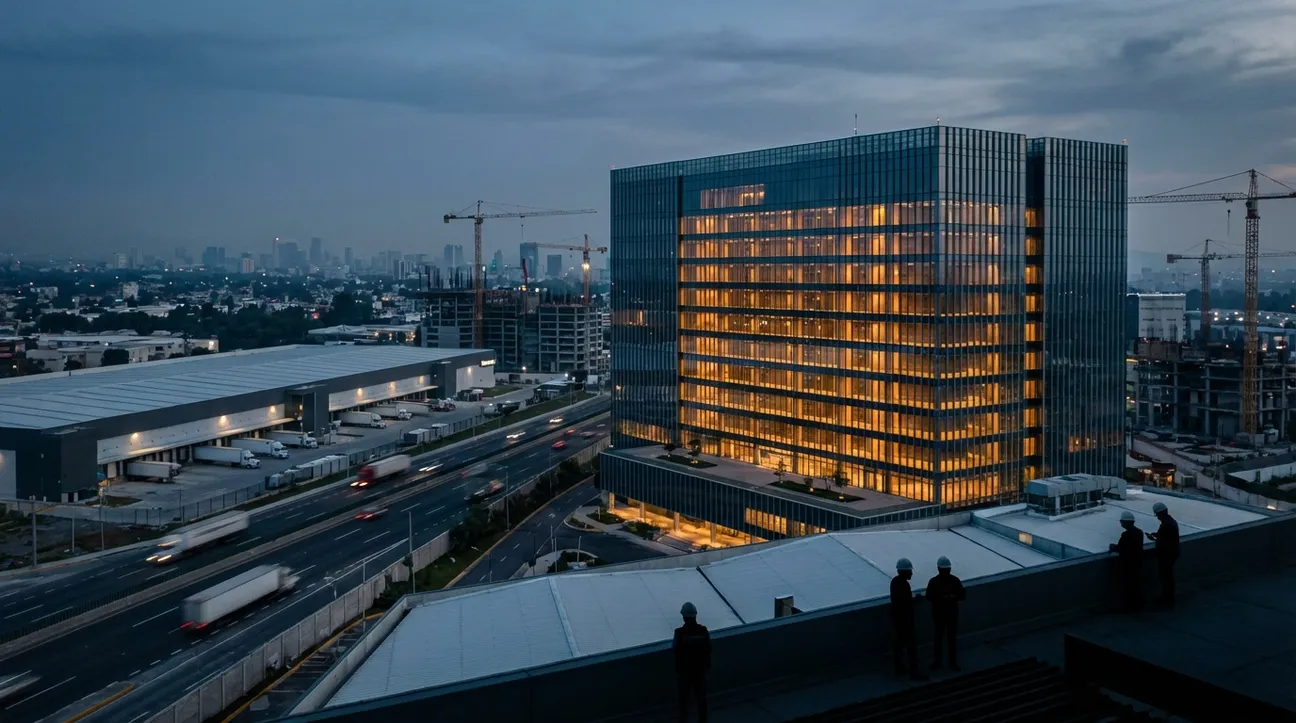
Beyond nearshoring: the specialized asset classes defining Mexico's second industrial cycle
Data centers, cold storage, reverse logistics, and micro-fulfillment form a new layer of sophistication demanding differentiated investment strategies.
Executive Summary
Key Takeaways
- Nearshoring was the first wave; Mexico's second industrial cycle is defined by specialized asset classes: data centers, cold storage, reverse logistics, and micro-fulfillment.
- Each segment has differentiated risk-return profiles, technical requirements, and tenant bases, making it impossible to treat them as a homogeneous category.
- Mexico faces a structural cold chain infrastructure deficit, representing an opportunity tied to its role as an agri-food exporter to the U.S.
- Competing in this cycle requires deep technical expertise, differentiated financing, tenant co-design, and proactive regulatory awareness.
- Those who remain in the generic model will face compressed margins and increasing commoditization.
Nearshoring opened the door, but the next industrial cycle demands a different conversation
Mexico's industrial boom driven by nearshoring consolidated logistics corridors, attracted institutional capital at an unprecedented scale, and positioned the country as the leading recipient of manufacturing relocations in Latin America. That first wave, centered on large-format logistics warehouses and Class A industrial parks, served its purpose: it generated critical mass, foundational infrastructure, and an ecosystem of developers, operators, and financiers aligned with demand from global companies diversifying their supply chains away from Asia.
But that model alone no longer captures the full scope of what is happening in Mexican industrial real estate. The conversation among leading institutional investors, developers, and logistics operators has shifted toward a more precise and demanding question: what types of industrial assets will capture value over the next three to five years, and which of them require technical, financial, and regulatory capabilities fundamentally different from those of the previous cycle.
The answer points toward an accelerated diversification of asset classes within the industrial segment. Data centers, cold chain facilities, reverse logistics centers, micro-fulfillment plants, and advanced manufacturing are neither marginal nor experimental categories. They represent the next layer of sophistication in a maturing market that demands a more granular strategic reading from its participants.
Why are data centers, cold storage, and reverse logistics reshaping the industrial investment map?
Each of these asset classes responds to a different structural demand logic, and that is precisely what makes them high-potential strategic opportunities.
Data centers. The expansion of Mexico's digital economy, combined with data sovereignty regulations gaining traction across Latin America, generates sustained demand for local processing and storage infrastructure. Data centers require specific conditions that radically set them apart from a conventional logistics warehouse: access to redundant, high-capacity power; low-latency fiber optic connectivity; sophisticated cooling systems; and physical and cybersecurity standards that significantly raise development costs but also returns. For investors, these assets offer long-term lease agreements with high-credit-quality tenants, typically hyperscalers and telecommunications companies. However, the technical barrier to entry is considerably higher than in traditional industrial, which limits competition and protects margins.
Cold storage and cold chain. The growth of food e-commerce, the expansion of the pharmaceutical industry, and regulatory requirements around food traceability are driving demand for temperature-controlled facilities. Mexico faces a structural deficit in cold chain infrastructure compared to mature markets. Cold chain facilities demand intensive investment in industrial refrigeration systems, specialized thermal insulation, and operating protocols that generate high operational costs but also premium rents. This segment also benefits from Mexico's geographic position as an agri-food exporter to the United States, adding a demand component linked to foreign trade.
Reverse logistics. The exponential growth of e-commerce brings with it a phenomenon few anticipated at its true scale: the volume of returns. Reverse logistics—the efficient management of product flows from the consumer back to the origin—requires facilities specifically designed for sorting, refurbishment, and redistribution. These centers operate with layout, flow, and technology logics that differ from those of a conventional distribution center. For developers who understand this specificity, the segment offers the opportunity to differentiate in a market where most of the supply remains generic.
Micro-fulfillment. The pressure to reduce delivery times in Mexico's major metropolitan areas drives demand for compact facilities located in urban or peri-urban zones, designed for automated order processing. These assets compete for land in locations where property values are significantly higher, altering traditional industrial development equations and requiring adapted financial models.
The convergence of these segments creates a landscape where industrial real estate is no longer a homogeneous category. Each asset class has its own risk-return profile, its own tenant base, its own technical requirements, and its own competitive dynamics.
What capabilities do developers and investors need to compete in this second cycle?
The transition toward specialized asset classes poses concrete challenges that go beyond the availability of capital.
Deep technical expertise. Developing a data center or a cold chain facility is not the same as building a logistics warehouse with standard specifications. It requires specialized engineering, equipment suppliers with experience in each vertical, and project management teams with a proven track record in complex assets. Developers who attempt to replicate their traditional model in these segments without incorporating specialized technical talent will face cost overruns, delays, and in the worst case, assets that fail to meet their tenants' operational specifications.
Differentiated financing structures. Specialized assets have distinct investment profiles. A data center may require double or triple the investment per square meter compared to a conventional logistics warehouse, but it generates proportionally higher rents and longer contracts. Financing structures must reflect these particularities. Investment vehicles that treat all industrial assets as a uniform category will miss opportunities or underestimate risks.
Strategic relationships with specialized tenants. In emerging asset classes, the tenant relationship takes on an almost partnership-like dimension. Data center operators, temperature-controlled logistics companies, and retailers demanding micro-fulfillment seek developers who understand their operational needs and can design tailored solutions. This capacity for listening and co-design becomes a decisive competitive advantage.
Proactive regulatory awareness. Each segment faces a specific regulatory environment. Data centers are subject to energy consumption regulations and, increasingly, data protection standards. Cold chain facilities must comply with national and international sanitary standards. Reverse logistics operates within a rapidly evolving regulatory framework for waste and the circular economy. Investors who incorporate this regulatory dimension into their due diligence analyses will make more informed decisions.
The role of decision-making communities in shaping the new industrial map
The growing sophistication of Mexico's industrial market demands forums where developers, investors, operators, and authorities can align visions and share market intelligence. Specialized asset classes raise questions that cannot be answered with macro-level absorption and vacancy data: they require granular analysis, operational experience, and a long-term perspective.
GRI Institute has identified this evolution as a central pillar of its agenda for the industrial and logistics segment in Mexico. The club's gatherings bring together the leading decision-makers in the Latin American industrial ecosystem—precisely the profiles actively evaluating diversification into data centers, cold chain, and last-mile logistics. This ability to convene the investor community around the right questions, at the right time, is what distinguishes strategic analysis from mere data compilation.
Mexico's second industrial cycle will be defined by those who understand that market sophistication is not optional but a condition of competitiveness. Specialized asset classes do not replace traditional nearshoring-driven industrial real estate—they complement and elevate it. Developers and investors who master this new layer of complexity will capture the most attractive returns over the next five years. Those who remain in the generic model will face compressed margins and growing competition for an increasingly commoditized product.
The question is no longer whether Mexico will consolidate its position as Latin America's industrial hub. The question is what type of assets will define that consolidation, and who will be prepared to develop them.