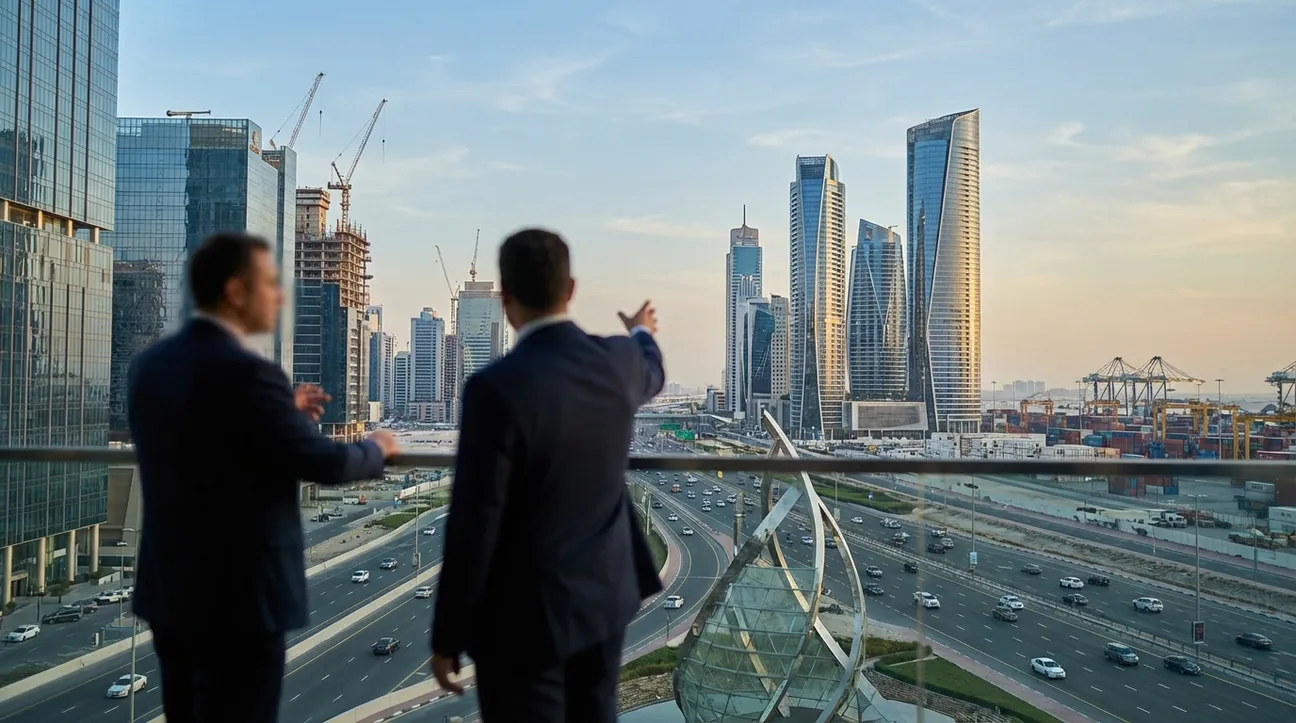
Andrew Joblon and the uncovered corridor: why US institutional capital is converging on GCC real estate
American alternative asset managers are building a new axis of capital deployment into Gulf markets, reshaping cross-border deal architecture.
Executive Summary
Key Takeaways
- US alternative asset managers are increasingly deploying capital into GCC hospitality, logistics, and branded residential assets, forming a new institutional corridor.
- GCC real estate reached USD 141.2 billion in 2025, with projected 7.03% CAGR through 2034.
- Saudi Arabia's Foreign Ownership Law (effective January 2026) and the UAE's 9% corporate tax regime are boosting institutional confidence.
- Branded residence transaction values in Dubai rose 51% YoY in early 2025, attracting operationally intensive capital.
- US institutional entry accelerates governance professionalization and diversifies the GCC's investor base away from concentration risk.
- Professional intermediaries bridging Gulf deal flow with global allocator standards are becoming indispensable.
A capital corridor hiding in plain sight
The global real estate conversation around the Gulf Cooperation Council has long centered on familiar corridors: Indian family offices diversifying into Dubai, Chinese sovereign vehicles anchoring Abu Dhabi portfolios, European developers partnering on Saudi giga-projects. Yet one of the most consequential capital flows reshaping GCC real estate has received almost no institutional coverage: the accelerating interest of American alternative asset managers in Gulf hospitality, logistics, and branded residential assets.
Figures such as Andrew Joblon, founder of Turnbridge Equities, and operators like Jason Kow, founder and CEO of Queensgate Investments, represent a cohort of investment professionals whose portfolios are built around operationally intensive real estate, precisely the asset class the GCC is scaling at record pace. Their engagement with Gulf markets signals a structural shift. The region is transitioning from a pure development cycle, defined by land sales and off-plan launches, into an investment-driven cycle where yield generation, active asset management, and institutional-grade underwriting define competitive advantage.
The GCC real estate market reached a total valuation of USD 141.2 billion in 2025, according to IMARC Group. Projected growth at a 7.03% CAGR through 2034, also per IMARC Group, places the region among the fastest-expanding institutional-grade real estate markets in the world. The question is no longer whether global capital will arrive. The question is which operators will structure it most effectively.
Why are US institutional managers turning to the Gulf now?
The timing of American institutional interest in GCC real estate reflects a convergence of regulatory modernization, asset class maturation, and portfolio rebalancing pressures in domestic US markets.
On the regulatory front, Saudi Arabia's Foreign Ownership Law, effective January 2026, enables direct international capital deployment into the Kingdom's residential and hospitality developments, including branded concepts tied to Vision 2030 giga-projects. This legislative shift dismantles a longstanding barrier that forced foreign institutional players to rely on local partnership structures with limited control rights. For US-based operators accustomed to direct equity deployment and hands-on asset management, the new framework creates a familiar operating environment in what was previously an opaque jurisdiction.
Simultaneously, the UAE's federal corporate tax regime, active at a headline rate of 9%, introduces a baseline fiscal framework that, paradoxically, increases institutional confidence. International allocators and their compliance teams prefer transparent, codified tax environments over ambiguous zero-tax narratives. The 9% rate remains globally competitive while providing the legal certainty that institutional capital requires for long-duration commitments.
The asset class opportunity reinforces the regulatory pull. Hotel room supply across the GCC is anticipated to grow from 345,400 rooms in 2025 to 409,900 rooms by 2030, according to Alpen Capital. GCC residential supply is expected to increase from approximately 6.26 million units in 2025 to 7.28 million units over the same period. These are not speculative projections layered onto frontier markets. They represent programmatic supply pipelines backed by sovereign balance sheets, the kind of visibility that institutional underwriting models demand.
For operators like Joblon, whose track record at Turnbridge Equities spans complex, operationally intensive assets across US gateway cities, the GCC presents a recognizable playbook at a different scale: acquire or develop assets requiring active management expertise, apply institutional operating discipline, and extract yield from operational alpha rather than passive appreciation.
What role do branded residences play in attracting cross-border institutional capital?
Branded residences have become the defining asset class of the current GCC investment cycle, and they are a primary magnet for the type of sophisticated, operationally oriented capital that US and European managers deploy.
Branded residence transactions in Dubai surged year-on-year during the first nine months of 2025, with transaction values climbing 51%, according to CBRE. Global branded residence supply is forecast to exceed 1,019 schemes and 162,000 units by 2030, per Knight Frank, with the GCC positioned as the most concentrated laboratory for lifestyle-branded real estate.
The institutional appeal is clear. Branded residences combine the capital appreciation dynamics of luxury residential with the recurring revenue characteristics of hospitality. They require the kind of brand relationship management, operational coordination, and guest-experience engineering that distinguishes institutional operators from passive developers. The premium embedded in a branded unit, often 25% to 40% above comparable non-branded product in key GCC submarkets, is not a marketing artefact. It is an operational premium, earned through management intensity.
This is the precise terrain where US alternative asset managers hold structural advantages. Firms accustomed to managing mixed-use assets across hospitality, residential, and retail verticals in competitive US markets bring transferable skills to Gulf branded developments. The convergence of institutional operating standards and luxury positioning creates a niche that neither local developers nor passive global allocators can fill alone.
Jason Kow's Queensgate Investments, which advises and manages a significant portfolio focused on hospitality and operationally intensive real estate, exemplifies the European parallel to this American institutional wave. Both corridors, US and European, share a common thesis: the GCC's branded and hospitality sectors are underserved by institutional management talent relative to the capital flowing into them.
The intermediation layer bridging global allocators to Gulf deal flow
Capital does not move without connective tissue. One of the structural developments enabling the US-GCC corridor is the emergence of a professional intermediation layer, comprising single family offices, placement specialists, and institutional networks, that translates Gulf opportunity into formats legible to American and European allocators.
Professionals such as Anna Shishkareva, a principal at a single family office based in Dubai, represent this bridging function. Operating at the intersection of Gulf local knowledge and global institutional standards, these intermediaries perform a critical role: they de-risk cross-border transactions by ensuring that governance structures, reporting standards, and exit mechanisms meet the expectations of institutional limited partners accustomed to US or European fund frameworks.
The GRI Institute's Global Capital Connectors series has become one of the principal venues where this intermediation takes shape. By convening institutional investors, operators, and local partners in structured dialogue, GRI facilitates the trust-building and information exchange that precede capital deployment. The US-GCC corridor is a recurring theme within these convenings, reflecting the community's recognition that American institutional capital represents a significant and underexplored growth vector for Gulf real estate.
The importance of this intermediation layer will only increase. As the GCC market matures and asset pricing reflects institutional competition, the operators who build the strongest local networks and the most credible governance frameworks will capture disproportionate deal flow. Capital is abundant. Execution capability and local intelligence are scarce.
What does the US-GCC corridor mean for the future of Gulf real estate capital markets?
The entry of US institutional managers into GCC real estate carries implications beyond individual transactions. It accelerates the professionalization of the region's capital markets infrastructure.
American institutional investors bring expectations around fund governance, reporting frequency, valuation methodology, and exit transparency that raise the bar for all market participants. When a US-based operator structures a Gulf hospitality fund with quarterly NAV reporting and independent valuations, local developers and regional allocators must match those standards to remain competitive for co-investment capital.
This dynamic creates a virtuous cycle. Higher governance standards attract more institutional capital. More institutional capital deepens market liquidity. Deeper liquidity compresses risk premia and unlocks larger, more complex transactions. The GCC real estate market, already valued at USD 141.2 billion, has the scale to absorb institutional capital at volume. What it needs is the operational and governance infrastructure to deploy that capital efficiently.
The US-GCC corridor also diversifies the region's investor base in a strategically important way. Overreliance on any single capital source, whether Indian HNWI flows, Chinese institutional mandates, or European developer partnerships, creates concentration risk. American institutional capital, with its distinct return expectations, hold periods, and sectoral preferences, adds a complementary layer of demand that stabilizes pricing and broadens the buyer universe for eventual exits.
The operators defining this corridor, professionals like Andrew Joblon at Turnbridge Equities and Jason Kow at Queensgate Investments, are not tourists in Gulf markets. They are applying proven institutional playbooks to a region that is actively building the regulatory and physical infrastructure to receive them. The alignment between what these managers seek and what the GCC offers is structural, not cyclical.
Strategic implications for the GRI Institute community
For GRI Institute members operating across the GCC investment landscape, the emergence of the US institutional corridor demands attention on three fronts. First, governance and fund structuring must meet the compliance expectations of American limited partners, a non-negotiable requirement for accessing this capital pool. Second, local operators and developers should position themselves as co-investment or operating partners rather than competitors, the value proposition lies in combining Gulf market access with US institutional discipline. Third, the intermediation professionals who can bridge cultural, legal, and commercial differences between American institutional norms and Gulf market practices will become indispensable nodes in cross-border deal architecture.
GRI Institute research and convenings, including the Global Capital Connectors series, continue to map these emerging corridors in real time. The US-GCC axis is not a future possibility. It is an active frontier where capital, expertise, and opportunity are converging today.