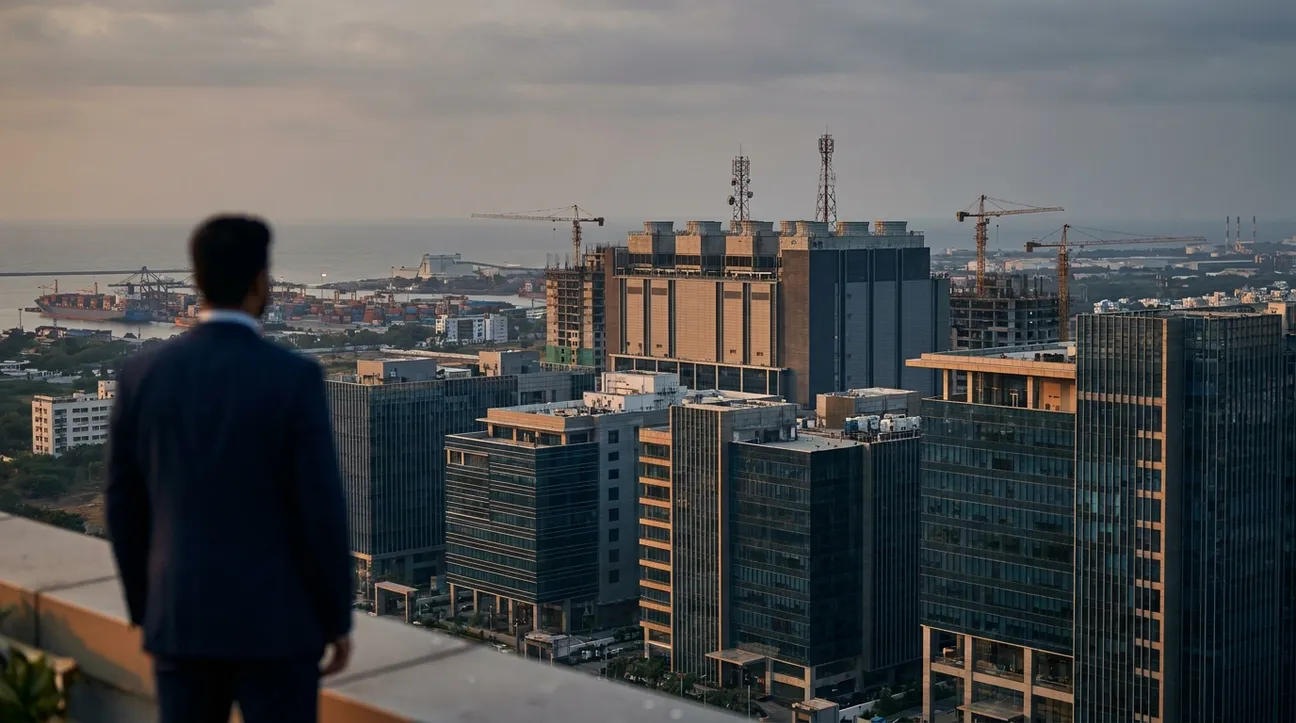
Ampa Palaniappan and the institutional capital architecture reshaping Chennai beyond commercial real estate
Chennai's convergence of luxury mixed-use platforms, data center corridors, and REIT-ready assets signals a structural shift in how institutional capital underwrites India's southern gateway.
Executive Summary
Key Takeaways
- Ampa Palaniappan's ₹2,000 crore Taj Sky View project introduces Chennai's first branded residences, with 60% of units booked by 2025.
- Chennai has attracted over ₹18,000 crore in disclosed data center investment commitments, with capacity forecast to reach 2.11 Thousand MW by 2032 (21.19% CAGR).
- REIT maturation in South India, exemplified by Bagmane Prime Office REIT, provides exit liquidity that encourages larger institutional commitments.
- Brookfield targets $100 billion in India AUM by 2030, requiring deep multi-asset markets like Chennai.
- Institutional investors evaluating Chennai through a single-asset lens risk underestimating its total opportunity.
Chennai is undergoing a transformation that institutional investors can no longer afford to categorize through a single asset-class lens. The city's real estate narrative, long anchored in IT office corridors and industrial parks, is fracturing into a multi-layered capital architecture that spans luxury branded residences, hyperscale data centers, and mixed-use townships. At the center of one of the most visible threads of this evolution stands Ampa Palaniappan, whose Ampa Group has engineered a platform that bridges hospitality, luxury residential, and large-format retail in ways that attract institutional-grade capital flows.
The broader picture is even more compelling. Chennai is now absorbing well over ₹18,000 crore (USD 2–2.5 billion) in disclosed data center investment commitments, according to a GRI Institute comparative analysis. Simultaneously, India's institutional real estate capital inflows reached $8.5 billion in the first half of 2026 alone, driven by major players including Brookfield and BF Group, as reported by GRI Hub News. These parallel currents are reshaping the city's capital map, and understanding how individual capital architects like Palaniappan fit within this macro convergence is essential for any institutional investor evaluating South India.
How is Ampa Palaniappan redefining Chennai's mixed-use institutional blueprint?
Ampa Palaniappan's most prominent current project, Taj Sky View, represents Chennai's first branded residences and a luxury mixed-use development valued at ₹2,000 crore. According to The Federal, 60% of the project's units have already been booked as of 2025, a pace that signals strong demand validation from high-net-worth buyers and, by extension, from the institutional capital that underwrites such developments.
The significance of Taj Sky View extends beyond a single project's absorption numbers. Branded residences occupy a particular position in the institutional capital hierarchy. They combine the yield stability of hospitality management with the capital appreciation dynamics of prime residential, creating a hybrid asset class that institutional platforms increasingly seek. In Chennai, a city where branded residential inventory has historically been negligible, Palaniappan's project establishes a proof of concept that could catalyze a broader pipeline.
Ampa Group's strategy reflects a pattern visible across India's most sophisticated developers: the construction of vertically integrated platforms that span multiple asset classes within a single urban corridor. Rather than building isolated commercial or residential assets, these platforms create ecosystems where retail, hospitality, office, and residential components reinforce each other's valuations. This approach generates the kind of predictable, diversified cash flows that institutional investors prize.
For GRI Institute members tracking South India's capital formation, this mixed-use institutional blueprint matters because it transforms Chennai from a market where institutional capital enters through single-asset transactions into one where platform-level investments become viable.
What makes Chennai's data center corridors a parallel institutional frontier?
While Ampa Palaniappan's footprint is concentrated in luxury mixed-use and retail, the city around him is building an entirely separate institutional frontier in digital infrastructure. Chennai's data center market is expected to grow from 0.55 Thousand MW in 2025 to 0.67 Thousand MW in 2026, according to Mordor Intelligence. The trajectory beyond that is even steeper: the same source forecasts the market reaching 2.11 Thousand MW by 2032, representing a compound annual growth rate of 21.19%.
This growth is underpinned by deliberate policy architecture. The Tamil Nadu Data Centre Policy (2021–2026) provides single-window clearances, guaranteed uninterrupted water and power supply, and allows sub-leasing of land and buildings in Data Centre Parks without transfer charges. At the national level, the Income Tax Act 2025 introduces a tax exemption under Serial No. 13C of Schedule IV for specified income of foreign companies arising from procuring data centre services from qualifying Indian data centres, effective from April 1, 2026 through March 31, 2047. Together, these frameworks create a regulatory environment specifically designed to channel institutional capital into digital infrastructure.
The corridors absorbing this capital, particularly along the Old Mahabalipuram Road (OMR), Ambattur, and Siruseri, overlap significantly with Chennai's established IT and commercial real estate geography. This spatial convergence creates a dynamic where data center buildout reinforces demand for adjacent mixed-use development: the engineers, operators, and corporate tenants who occupy data center campuses also require residential, retail, and hospitality infrastructure.
Chennai's data center boom is not occurring in isolation from the city's broader real estate transformation. It is an integral component of the same institutional capital architecture that Palaniappan's mixed-use projects exemplify, even if the direct financial linkages between these asset classes flow through different vehicles.
How does the REIT maturation of South Indian real estate validate the institutional thesis?
The institutional capital architecture in South India gains additional structural depth through the maturation of Real Estate Investment Trust (REIT) vehicles. Bagmane Group, with Shashank Bagmane associated as a Non-Executive Director of Bagmane Realty Investment Manager Private Limited, the entity managing the Bagmane Prime Office REIT, according to Investing.com, represents a benchmark for how South Indian commercial assets are transitioning from developer-held portfolios to publicly traded institutional instruments.
This REIT maturation matters for the broader Chennai narrative because it demonstrates the full lifecycle of institutional capital architecture: assets move from development to stabilization to securitization, creating liquidity events that attract successive waves of capital. When a market like South India can support REIT listings, it signals to global institutional investors that the exit infrastructure exists, which in turn encourages larger initial commitments.
The scale of institutional ambition in India reinforces this trajectory. Brookfield targets $100 billion in India Assets Under Management by 2030, as reported by GRI Hub News. Such targets are only achievable if India's secondary and tertiary markets, including Chennai, offer sufficient institutional-grade inventory across multiple asset classes. The convergence of mixed-use platforms like Ampa Group's, data center corridors absorbing billions in commitments, and REIT vehicles providing exit liquidity creates precisely the kind of deep, multi-layered market that global institutional capital requires.
The convergence thesis: why Chennai demands a multi-asset institutional lens
The conventional approach to evaluating Chennai's real estate market treats commercial office, residential, data centers, and industrial as separate verticals with distinct capital stacks. This framework is increasingly inadequate.
Chennai's institutional capital architecture is converging around corridors where Global Capability Centers (GCCs) drive office demand, data centers absorb hyperscale digital infrastructure investment, and mixed-use townships provide the residential and retail ecosystems that anchor long-term occupancy. Capital architects who understand this convergence, whether they operate in branded residences like Ampa Palaniappan or in commercial REITs like the Bagmane platform, are building assets that benefit from multiple demand drivers simultaneously.
The policy environment reinforces this convergence. Tax exemptions for foreign data center procurement, single-window clearances for digital infrastructure, and the broader institutional maturation of Indian real estate through REIT structures all reduce friction for capital deployment across asset classes. Institutional investors evaluating Chennai through a single-asset lens risk underestimating the city's total addressable opportunity.
GRI Institute's ongoing research into Indian real estate capital flows, including discussions at its India-focused events and within its leadership community, consistently surfaces this convergence as a defining theme. Members engaged in cross-border capital allocation increasingly view Chennai as a market where the institutional infrastructure, both physical and regulatory, supports platform-level investments rather than isolated transactions.
The city that institutional coverage still sometimes treats as secondary to Mumbai, Bangalore, or Delhi-NCR is building a capital architecture of remarkable breadth. The question for institutional investors is whether they will recognize this structural shift early enough to participate in its most attractive vintage.
Chennai's transformation is not a forecast. It is underway, visible in ₹2,000 crore branded residence projects, in over ₹18,000 crore of data center commitments, and in the REIT vehicles that are converting South Indian commercial assets into globally tradable instruments. The capital architects shaping this transformation, Ampa Palaniappan among the most prominent, are building the platforms through which institutional capital will flow into India's southern gateway for the next decade.