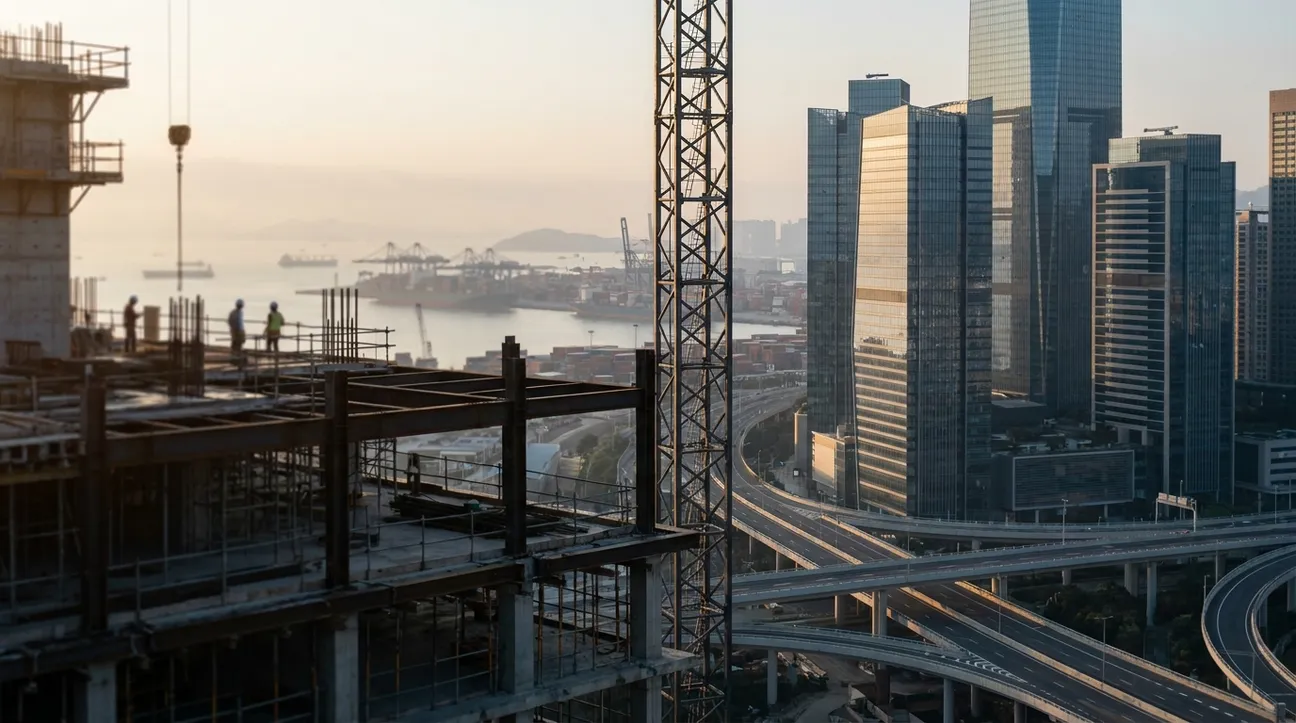
Vertically integrated conglomerates are redefining how the GCC builds, owns, and operates real estate
From AIMS Holding in Saudi Arabia to MRBF Holding in the UAE, a new generation of diversified platforms bridges infrastructure contracting and real estate development at scale.
Executive Summary
Key Takeaways
- Vertically integrated GCC conglomerates control the full project lifecycle—from construction to branded hotel operations—capturing margin at every stage.
- The GCC real estate market is projected to grow from USD 141.2B (2025) to USD 260.3B by 2034 at a 7.03% CAGR.
- Regulatory reforms in Saudi Arabia and Dubai are favoring scaled, compliance-ready operators over fragmented developers.
- AIMS Holding's IHG Regent Hotel in Makkah exemplifies the triple-capture model: construction, real estate, and hospitality asset.
- Co-living and alternative assets are extending the integrated model into emerging emirates and newer asset classes.
The rise of integrated real estate-to-infrastructure platforms across the Gulf
A structural shift is underway in the Gulf Cooperation Council's real estate market. A cohort of homegrown conglomerates, vertically integrated across construction, infrastructure, hospitality, and development, is consolidating influence across the region's fastest-growing asset classes. These groups do not merely develop properties. They control supply chains, manage execution risk internally, and deploy capital across the full lifecycle of a project, from earthworks to branded hotel operations.
The GCC real estate market was valued at USD 141.2 billion in 2025 and is projected to reach USD 260.3 billion by 2034 at a compound annual growth rate of 7.03%, according to GRI Institute research. That trajectory, powered by sovereign diversification agendas and sustained population growth, demands a class of operator capable of delivering complex, mixed-use projects on aggressive timelines. Vertically integrated conglomerates are emerging as the natural answer.
AIMS Holding, a Saudi-based conglomerate founded by Sheikh Abdullah Ibrahim Al Subeaei, exemplifies this model. With operations spanning real estate development, construction, and infrastructure, AIMS has built a platform designed to capture value at every stage of project delivery. In 2025, the group partnered with IHG Hotels & Resorts to launch the ultra-luxury Regent Hotel in Makkah, a 330-room property that positions AIMS at the intersection of hospitality, religious tourism, and premium real estate in the Kingdom's most strategically significant city.
In the UAE, MRBF Holding, led by Chairman Mohammed Alfalasi, follows a comparable logic. The Abu Dhabi-adjacent conglomerate operates across real estate and contracting verticals, leveraging internal capabilities to compress development timelines and retain margin that would otherwise flow to third-party contractors. These are capital-efficient structures purpose-built for a region where speed of execution and project scale are competitive advantages.
Vertically integrated conglomerates represent the GCC's institutional response to the coordination failures that plague fragmented development markets. By internalizing contracting, procurement, and asset management, these groups reduce interface risk and accelerate delivery, qualities that sovereign clients and international brand partners increasingly demand.
Why are vertically integrated models gaining ground in the GCC?
The answer lies in the intersection of three forces: unprecedented pipeline scale, regulatory modernization, and the region's hospitality-led development thesis.
Regional residential supply across the GCC is expected to increase from approximately 6.26 million units in 2025 to 7.28 million units by 2030, according to Alpen Capital. Absorbing that volume requires developers who can also build, and who can do so without relying on overstretched third-party contractors competing for the same labor and materials across multiple mega-projects.
Regulatory reform is further tilting the landscape toward professionalized, compliance-ready operators. Saudi Royal Decree No. M/14, the Law of Real Estate Ownership and Investment by Non-Saudis, took effect on January 22, 2026, establishing a zone-based model that allows non-Saudi individuals and foreign companies to own real estate in designated areas. This framework opens the Kingdom's market to international capital, but it also raises the bar for developers seeking to partner with foreign investors who require institutional-grade counterparties.
In Dubai, Law No. 4 of 2026 introduced a regulatory framework aimed at professionalizing the real estate market, favoring compliance-first operators. The direction of regulation across the GCC is unmistakable: markets are selecting for scale, transparency, and operational depth, precisely the attributes that vertically integrated conglomerates possess.
Dubai's Q1 2026 real estate transaction volume reached AED 252 billion, according to GRI Institute data, underscoring the sheer velocity of capital flowing through the region's property markets. Capturing a meaningful share of that flow requires not just development capability but the infrastructure backbone to deliver.
AIMS Holding's Makkah Regent Hotel illustrates how integrated platforms convert infrastructure competence into premium branded assets. The partnership with IHG signals that global hospitality operators are willing to entrust ultra-luxury brand equity to regional conglomerates that demonstrate end-to-end delivery capacity. For AIMS, the project is simultaneously a construction mandate, a real estate play, and a long-duration hospitality asset, a triple capture of value that siloed developers and contractors cannot replicate.
How is the co-living and alternative asset class extending the integrated model?
The vertically integrated thesis is not confined to mega-hospitality projects. Emerging operators are applying similar principles to newer asset classes, particularly co-living and flexible workspace.
Hive Development, backed by A.R.M Holding, is pioneering the co-living segment in the UAE. In 2024, Hive partnered with RAK Properties for a 233-key development in Mina Al Arab, Ras Al Khaimah, featuring a 117-unit co-living building and 2,000 square meters of coworking space. The project signals two important trends: the geographic diversification of development capital beyond Dubai and Abu Dhabi into emerging emirates, and the willingness of integrated groups to underwrite asset classes that lack deep transaction histories in the region.
Co-living represents the frontier where operational intensity meets development risk, a combination that rewards operators who control both the physical asset and the service layer. Hive's expansion from Dubai into Ras Al Khaimah suggests that vertically integrated models are portable across the UAE's diverse regulatory and demand environments.
The co-living and co-working segments also speak to a demographic reality. The GCC's expatriate-heavy workforce, combined with a growing cohort of digital professionals and entrepreneurs, creates demand for flexible, community-oriented living formats that traditional residential developers are ill-equipped to deliver. Operators like Hive, with integrated development and management capabilities, are positioned to define the category.
What strategic questions should institutional investors be asking?
For institutional capital allocators evaluating the GCC, the rise of vertically integrated conglomerates reframes the due diligence conversation. Three questions merit particular attention.
First, how should investors assess concentration risk in groups that serve as both developer and contractor on the same project? The efficiency gains are real, but so is the potential for misaligned incentives when cost overruns on the construction side erode returns on the development side. Robust governance frameworks and independent project oversight become essential.
Second, how deep are the management benches within these conglomerates? Rapid expansion across geographies and asset classes strains leadership capacity. The ability to attract and retain senior talent with cross-border experience will determine which groups scale successfully and which overextend.
Third, how will these platforms navigate the growing presence of international capital under Saudi Arabia's new ownership framework? The zone-based model introduced by Royal Decree No. M/14 creates joint venture and co-investment opportunities, but also demands that local partners meet international standards of reporting, compliance, and stakeholder communication.
These are the questions that GRI Institute's senior membership community is actively debating. Through its GCC-focused events and research programs, the institute convenes the principals and chief executives who lead these conglomerates alongside the global institutional investors seeking exposure to the region's growth trajectory. The conversations are candid, data-driven, and oriented toward actionable insight, reflecting the maturity of a market that has moved well beyond speculative exuberance.
The competitive landscape ahead
The GCC's trajectory toward USD 260.3 billion in real estate market value by 2034 will not be captured by any single operator model. Pure-play developers, asset-light fund managers, and international branded operators all retain important roles. Yet the vertically integrated conglomerate, capable of delivering infrastructure, developing real estate, and operating branded hospitality assets within a single corporate structure, occupies an increasingly central position.
AIMS Holding's partnership with IHG in Makkah, MRBF Holding's multi-vertical operations in the UAE, and Hive Development's co-living expansion into Ras Al Khaimah are distinct expressions of the same underlying logic. Control the value chain, and you control the margin, the timeline, and the relationship with capital.
As regulatory frameworks across Saudi Arabia and the UAE continue to professionalize, the competitive moat around well-governed, vertically integrated platforms will deepen. The groups that combine execution capacity with institutional governance will define the next chapter of GCC real estate, not as contractors who happen to develop, but as fully integrated platforms that build, own, and operate at regional scale.
GRI Institute will continue to track the strategies, partnerships, and capital structures of these emerging conglomerates through its dedicated GCC research and executive engagement programs. For senior leaders seeking to understand where the region's real estate market is heading, the integrated platform model is no longer a niche strategy. It is becoming the standard.