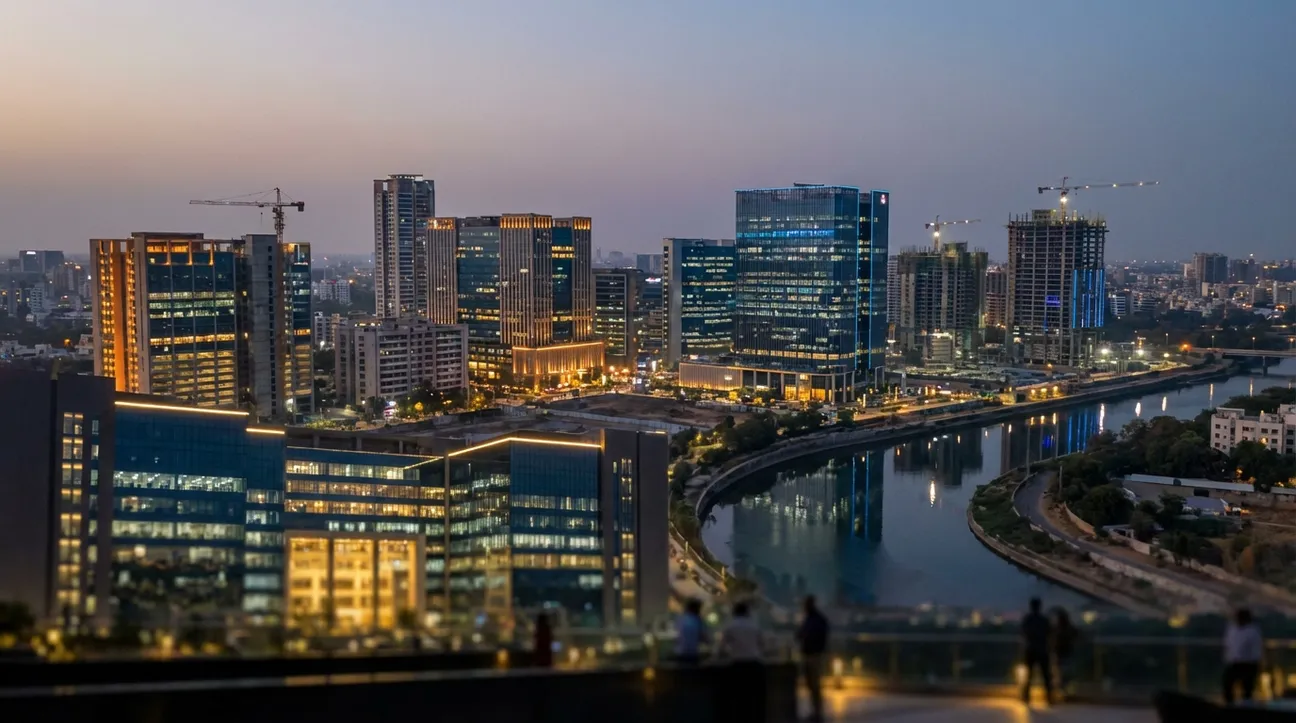
Ahmedabad's real estate institutional moment: capital platforms and developer strategies reshape Gujarat
Steady residential sales, a maturing office market and GIFT City's global ambitions position Ahmedabad as India's next institutional real estate corridor.
Executive Summary
Key Takeaways
- Ahmedabad recorded 18,752 residential units sold in 2025 (+2% YoY), maintaining positive momentum while peer metros contracted.
- GIFT City ranked 46th on the Global Financial Centres Index, with residential prices appreciating ~94% over the past decade and rental yields of 3–5%.
- Gujarat's GCC Policy 2025-30 targets 250 new Global Capability Centres, creating a structured demand pipeline for Grade A office space.
- GIFT City's workforce is projected to grow sixfold to 150,000 by 2030, driving layered demand across housing, retail and hospitality.
- NHAI's FY26 asset monetisation targets ₹30,000–40,000 crore, catalysing new real estate corridors along Gujarat's highway network.
Ahmedabad recorded 18,752 residential units sold in 2025, a 2% year-on-year increase that underscores the city's quiet but consistent ascent among India's top real estate markets, according to Knight Frank India. While several leading metros saw volume contractions last year, Gujarat's commercial capital maintained positive momentum across both residential and commercial segments, drawing attention from institutional investors, domestic developers and diaspora capital sources that had historically concentrated on Mumbai, Bangalore and the National Capital Region.
The data tells a story of structural resilience rather than speculative exuberance. Average residential prices in Ahmedabad rose 3% year-on-year to ₹3,120 per square foot in the second half of 2025, per Knight Frank India. The city's affordability relative to peer metros, combined with a healthy 'Quarter to Sell' metric of 7.6 quarters, signals a market driven by genuine end-user demand rather than investor-led froth. For institutional capital seeking stable, yield-oriented deployments in Indian real estate, Ahmedabad now presents a compelling entry point.
Why is Ahmedabad attracting institutional real estate capital in 2025?
The answer lies in the convergence of three forces: sustained residential demand at affordable price points, an office market reaching critical scale, and the transformative effect of GIFT City on the entire Ahmedabad-Gandhinagar corridor.
Ahmedabad's office market recorded leasing of 2.0 million square feet for the full calendar year 2025, with 1.2 million square feet transacted in the second half alone, according to Knight Frank India. These volumes reflect growing occupier confidence in the city's commercial infrastructure, particularly along the SG Highway corridor where technology firms and Global Capability Centres are establishing operations.
The Gujarat Global Capability Center Policy, 2025-30, issued in February 2025, aims to establish Gujarat as a hub for GCCs by targeting 250 new centres through subsidies on capital expenditure, operating expenditure and electricity duty. This policy framework creates a structured demand pipeline for Grade A office space, a dynamic that institutional investors and developers can underwrite with greater conviction than speculative commercial builds. Ahmedabad's office market is transitioning from an opportunistic play to a fundamentally supported growth corridor.
Professionals such as Pranav Thanawala, VP of Real Estate at RRC Ventures Pvt Ltd, who specialises in strategic property investments and portfolio management, exemplify the calibre of operator now active in this geography, according to GRI Institute. The entry of structured capital platforms with professional portfolio management capabilities marks a qualitative shift in how Ahmedabad's real estate market is capitalised and governed.
What role does GIFT City play in reshaping Gujarat's real estate trajectory?
GIFT City has moved from conceptual ambition to measurable institutional relevance. The financial district ranked 46th on the Global Financial Centres Index in March 2025, according to PwC India. GIFT NIFTY recorded a monthly turnover of USD 102.35 billion in May 2025, also per PwC India. These are not aspirational projections; they represent operational scale that is already generating demand for residential, commercial and mixed-use real estate in the surrounding corridor.
GIFT City is acting as a major catalyst for premium residential and commercial real estate development, attracting significant NRI and diaspora capital seeking tax-compliant assets within India's regulatory framework. Residential prices in GIFT City have appreciated approximately 94% over the past decade, with current rental yields ranging between 3% and 5%, according to Vitalspace. For diaspora investors seeking transparent, institutionally governed entry points into Indian real estate, GIFT City offers a regulatory environment that mirrors international financial centre standards.
The employment expansion planned for GIFT City adds a forward-looking demand catalyst. According to PwC India, the district's workforce is projected to grow from 25,000 to 150,000 jobs over the next five years, primarily in FinTech and technology roles. A sixfold increase in employment within a concentrated geography will generate substantial demand for housing, retail, hospitality and social infrastructure, creating layered investment opportunities across the real estate value chain.
GIFT City's planned employment expansion from 25,000 to 150,000 workers by 2030 represents one of India's most concentrated demand creation events for mixed-use real estate development.
Infrastructure monetisation and new real estate micro-markets
Ahmedabad's institutional real estate story extends beyond the city's traditional boundaries. India's highway infrastructure programme is creating new development corridors that connect Gujarat's urban centres to logistics and industrial demand nodes.
Highway Concessions One Private Limited manages and operates seven road assets held by infrastructure funds managed by Global Infrastructure Partners India LLP, according to GRI Institute. This institutional management model for highway assets demonstrates how professionally governed infrastructure platforms are opening adjacent real estate micro-markets for logistics parks, warehousing and mixed-use development along key corridors.
The broader policy framework supports this trend. NHAI's asset monetisation strategy for FY26 targets 24 road assets spanning 1,472 kilometres, with a fundraising objective of ₹30,000 to ₹40,000 crore through Toll-Operate-Transfer bundles and InvIT transfers, according to the Ministry of Road Transport and Highways and GRI Institute. This non-budgetary funding mechanism aims to ensure a steady capital stream for new highway construction while catalysing real estate development along freshly connected corridors.
Institutional highway management is creating a new category of real estate opportunity along Gujarat's expanding road network, linking infrastructure capital and property development in ways that demand integrated investment strategies.
Ahmedabad's position in India's evolving real estate hierarchy
India's real estate investment discourse has long been dominated by a handful of metros. Mumbai commands the largest share of institutional capital. Bangalore and Hyderabad attract technology-driven office demand. The NCR absorbs the most residential volume. Ahmedabad has operated below this narrative threshold, yet its fundamentals increasingly merit parity of attention.
The city offers a rare combination of attributes for institutional capital: affordable residential price points that sustain end-user demand, a growing office market supported by active government policy on GCC attraction, a globally recognised financial district generating premium demand, and expanding infrastructure connectivity that opens new development corridors. The market's healthy QTS of 7.6 quarters suggests inventory discipline, reducing the overhang risk that has plagued other Indian metros during correction cycles.
For capital allocators evaluating Indian real estate exposure beyond the established gateway cities, Ahmedabad's data profile demands serious consideration. The convergence of stable residential fundamentals, policy-backed commercial expansion and GIFT City's institutional magnetism creates a multi-layered opportunity set.
Ahmedabad's combination of residential affordability, GIFT City's global financial centre status and Gujarat's GCC policy framework positions the city as India's most underappreciated institutional real estate market.
How are diaspora capital flows influencing Ahmedabad's real estate market?
GIFT City's regulatory architecture, designed to mirror international financial centre standards, has become a focal point for NRI and diaspora capital seeking compliant and transparent pathways into Indian real estate. While precise quantitative volumes of diaspora capital flowing into Ahmedabad remain difficult to isolate from broader Gujarat and national data, the structural incentives are clear. GIFT City offers a regulatory environment that reduces the friction traditionally associated with cross-border real estate investment in India, from taxation clarity to institutional governance standards.
The 94% price appreciation in GIFT City over the past decade, combined with rental yields of 3% to 5%, provides a performance track record that diaspora investors can evaluate against comparable international benchmarks. As GIFT City's employment base scales toward 150,000 workers, the demand fundamentals supporting these returns are expected to strengthen further.
GRI Institute's upcoming Ahmedabad roundtable brings together developers, capital allocators and infrastructure operators active in this corridor, reflecting the growing institutional interest in Gujarat's real estate dynamics. The event signals a broader recognition among senior industry leaders that Ahmedabad has crossed the threshold from emerging to investable, a transition that editorial and analytical coverage must now reflect.
What comes next for Ahmedabad's real estate market
The 2025-2028 period will likely determine whether Ahmedabad consolidates its position as a genuine institutional real estate market or remains a secondary allocation for investors focused on India's established gateway cities. The data available today, steady residential volumes, disciplined pricing, growing office absorption and GIFT City's operational momentum, supports the case for the former.
Capital platforms with professional governance, policy frameworks that create structured demand through GCC incentives, and infrastructure monetisation strategies that open new micro-markets collectively form an investment thesis that is both diversified and fundamentally anchored. Ahmedabad's institutional moment is not a projection. It is already underway.