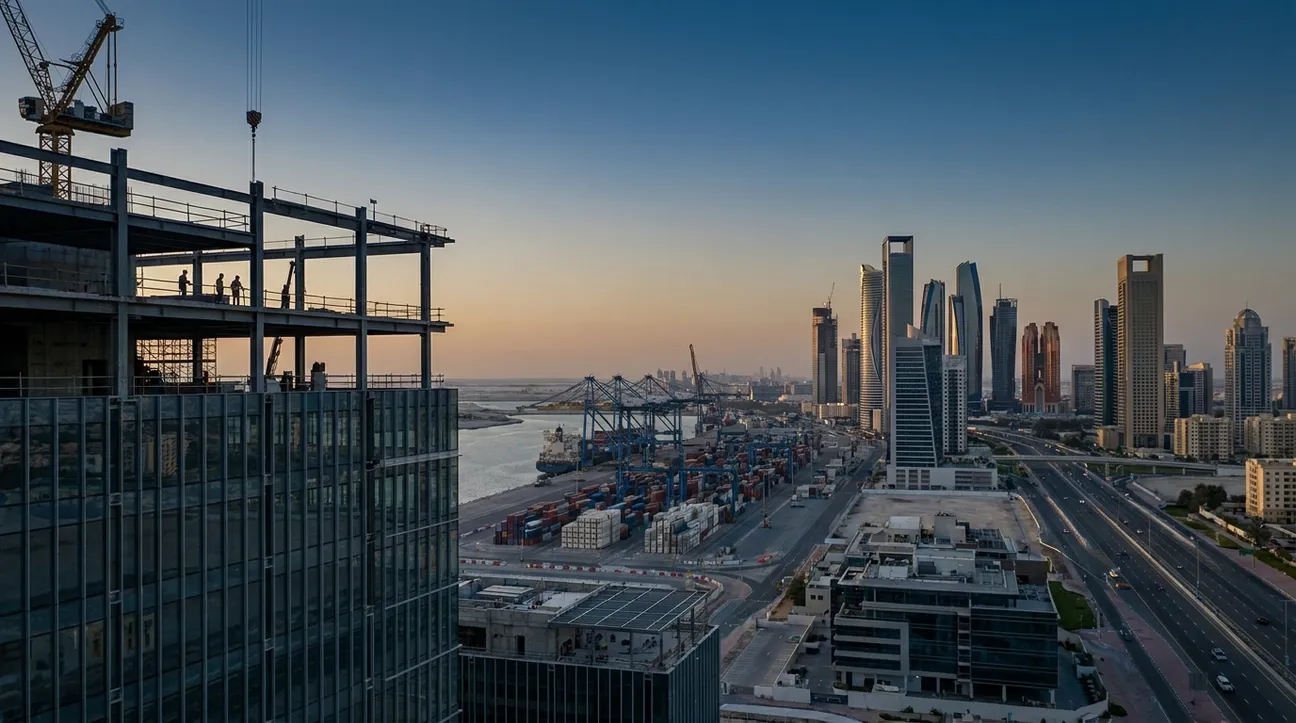
Agility Global's $196 million revaluation and the logistics-to-mixed-use conversion economics reshaping GCC real estate
Legacy land banks, regulatory shifts, and infrastructure megaprojects are converging to unlock a new asset class across the Gulf Cooperation Council.
Executive Summary
Key Takeaways
- Agility Global booked $196M in revaluation gains by reclassifying logistics assets to mixed-use, proving conversion economics at scale.
- Saudi Arabia's 2026 Foreign Ownership Law and Abu Dhabi's Administrative Decision No. 25/2025 are removing regulatory barriers to land reclassification.
- Aldar's $177M acquisition of KEZAD logistics assets validates competitive interest in industrial-to-mixed-use repositioning.
- CCCC's $3.97B Kuwait port contract illustrates the infrastructure pipeline feeding future conversion candidates.
- The GCC real estate market is projected to nearly double to $260.3B by 2034, underpinning long-term demand.
Agility Global booked one-off revaluation gains of USD 196 million on investment properties in Q4 2025 by repositioning logistics assets toward mixed-use classifications, according to First Abu Dhabi Bank (FAB) Research. The figure crystallizes a structural shift accelerating across the Gulf Cooperation Council: conglomerates with sprawling logistics land banks are converting undervalued industrial footprints into higher-density, mixed-use developments, capturing substantial value arbitrage in the process.
The transaction is significant because it signals that the economics of conversion have reached a tipping point. Across a GCC real estate market currently valued at over USD 140 billion, according to GRI Institute analysis, asset owners are discovering that legacy logistics plots located in urbanizing corridors now warrant reclassification and redevelopment. The implications extend well beyond a single balance sheet.
Agility Logistics Parks: scale and trajectory
Agility's logistics platform spans Kuwait, Saudi Arabia, and the UAE, anchored by Agility Logistics Parks (ALP). The subsidiary is targeting an exit run-rate of USD 86 million by the end of 2026, according to FAB Research, a figure that reflects both organic lease growth and the portfolio repositioning that generated the Q4 2025 revaluation gains.
The strategy rests on a straightforward premise. Agility accumulated large logistics land banks during the region's earlier infrastructure build-out phase, when industrial plots traded at a fraction of current urban land values. As GCC cities expand outward and population density increases around formerly peripheral logistics hubs, the highest-and-best-use calculus shifts from single-use warehousing to mixed-use developments incorporating residential, retail, and commercial components.
The USD 196 million revaluation gain demonstrates that auditors and appraisers now validate this reclassification at portfolio scale. For institutional investors tracking the GCC's real estate evolution, this represents a quantifiable proof point that conversion economics deliver measurable returns.
How are regulatory shifts enabling these conversions?
Two regulatory developments are accelerating the logistics-to-mixed-use pipeline across the GCC's two largest markets.
In Saudi Arabia, the 2026 Foreign Ownership Law expands foreign ownership rights and enables flexible land use, accelerating the reclassification of legacy logistics land banks toward mixed-use developments. The legislation removes a key friction point that previously constrained international capital from participating in redevelopment plays on industrial land.
In Abu Dhabi, Administrative Decision No. 25/2025 creates regulatory frameworks clarifying mixed-use property regimes, enabling flexible land use and broader investor participation. The decision provides the legal certainty that developers and their lenders require before committing capital to conversion projects.
Together, these reforms lower the regulatory barriers that historically locked logistics land into single-use zoning. They also widen the investor base, creating conditions for joint ventures between local landholders and international capital partners.
GRI Institute members participating in Gulf-focused discussions have consistently identified regulatory modernization as the single most important catalyst for unlocking stranded land value across the region. The 2026 Saudi and Abu Dhabi measures validate that thesis with concrete policy action.
The peer landscape: Aldar, KEZAD Group, and industrial-to-real-estate repositioning
Agility is not operating in isolation. In April 2026, Aldar Properties acquired an industrial and logistics portfolio from AD Ports Group's KEZAD Group for AED 650 million (USD 177 million), adding 163,000 square meters of space, according to disclosures from both companies. The transaction confirms that Abu Dhabi's leading listed developer views industrial and logistics assets as a strategic growth vector.
Aldar's acquisition approach differs from Agility's organic conversion model. Where Agility is reclassifying and redeveloping its own land, Aldar is acquiring third-party logistics portfolios at industrial valuations with the intention of managing them as income-producing assets and, over time, capturing density uplift as master plans evolve.
Both strategies exploit the same underlying dynamic: industrial and logistics real estate in urbanizing GCC corridors is structurally undervalued relative to its long-term development potential. The difference lies in execution, with Agility leveraging its legacy land position and Aldar deploying acquisition capital.
The convergence of these two approaches from two of the region's most sophisticated real estate operators validates the logistics-to-mixed-use thesis as a durable trend rather than an isolated opportunistic play.
What role does mega-infrastructure investment play in conversion economics?
Logistics-to-real-estate conversions depend on the foundational transport and port infrastructure that makes logistics hubs viable in the first place. As these networks mature and urban areas grow around them, the conversion opportunity emerges.
China Communications Construction Company (CCCC) secured a USD 3.97 billion EPC contract for Phase 1 of Kuwait's Mubarak Al-Kabeer Port, with site preparations beginning in January 2026, according to reporting by Zawya and Times Kuwait. The megaproject illustrates the infrastructure investment cycle that precedes and enables real estate value creation.
Mubarak Al-Kabeer Port will anchor a new logistics corridor in Kuwait, generating demand for warehousing, distribution, and support facilities in surrounding areas. Over time, as the port matures and the surrounding area urbanizes, the same conversion dynamic playing out with Agility's existing logistics parks could repeat with the new infrastructure.
Mega-infrastructure contractors like CCCC provide the essential transport connectivity layer. Without port capacity, road networks, and rail links, logistics land has limited value. With them, it becomes the feedstock for the next generation of mixed-use urban development.
This infrastructure-to-logistics-to-mixed-use value chain represents one of the GCC's most distinctive real estate investment narratives. It ties together sovereign infrastructure spending, private logistics operators, and real estate developers in a sequence that can span decades.
Mid-tier conglomerates and vertically integrated platforms
The conversion trend extends beyond the region's largest players. AIMS Holding, a mid-tier Saudi conglomerate, is building vertically integrated real estate footprints across the GCC and partnered with IHG to develop the first Regent-branded hotel in Makkah, according to Gulf Property. The strategy reflects a broader pattern of diversified conglomerates leveraging existing land and infrastructure positions to move up the real estate value chain into hospitality, branded residences, and mixed-use developments.
In the UAE, Kaizen Asset Management Services manages an asset portfolio valued at USD 6 billion (AED 18 billion) across more than 130 projects, according to disclosures at the World Realty Congress. The scale of third-party asset management activity signals that institutional capital increasingly requires professional management across diversified GCC real estate portfolios, including assets undergoing reclassification and repositioning.
Both examples illustrate that the logistics-to-mixed-use conversion opportunity is accessible across the capital structure, from large-cap listed platforms like Agility and Aldar to mid-tier conglomerates and specialized asset managers.
Market trajectory: a USD 260 billion horizon
The GCC real estate market is projected to nearly double to USD 260.3 billion by 2034, according to GRI Institute analysis. That growth trajectory provides the demand-side foundation for conversion economics. As populations expand, urban footprints grow, and economic diversification programs generate new commercial activity, the pressure to unlock underutilized logistics and industrial land intensifies.
Conversion plays capture value at the intersection of two powerful trends: the structural growth of GCC real estate markets and the regulatory modernization that enables flexible land use. Operators holding legacy logistics land banks are positioned to benefit disproportionately as these trends compound.
For capital allocators, the key metric to monitor is the pace at which regulatory frameworks evolve. The 2026 Saudi Foreign Ownership Law and Abu Dhabi's Administrative Decision No. 25/2025 demonstrate that policymakers are actively clearing the path. Each additional regulatory clarification widens the conversion opportunity set.
Strategic implications for institutional capital
The data points assembled here outline a clear investment thesis. Agility Global's USD 196 million revaluation gain provides the proof of concept. Aldar's USD 177 million acquisition of KEZAD logistics assets confirms competitive validation. CCCC's USD 3.97 billion port contract in Kuwait illustrates the infrastructure pipeline that creates future conversion candidates. And regulatory reforms in Saudi Arabia and Abu Dhabi supply the enabling conditions.
Institutional investors evaluating GCC real estate allocations should consider logistics and industrial assets as a distinct entry point into the broader mixed-use development cycle. The conversion economics are quantifiable, the regulatory environment is supportive, and the demand trajectory through 2034 is robust.
As GRI Institute members have observed in recent regional forums, the GCC's next wave of real estate value creation will emerge from assets that do not yet look like real estate on a traditional classification basis. Legacy logistics land banks, industrial parks, and infrastructure-adjacent plots represent the raw material. The conversion economics are the catalyst.