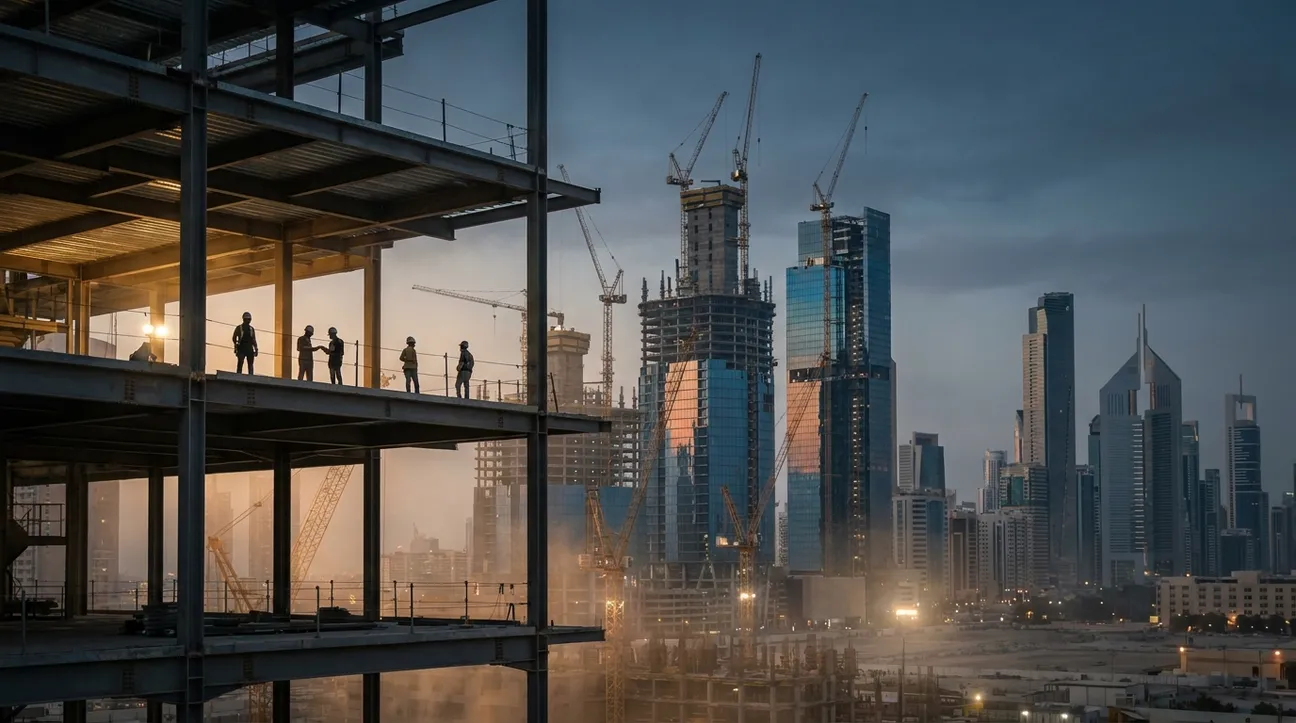
Abdulla Lahej and the sovereign-trained Emirati architects reshaping how Gulf mega-projects compete for global design authority
A new cohort of locally cultivated architects and developer-founders is challenging the dominance of international starchitect firms across the GCC's USD 141 billion real estate market.
Executive Summary
Key Takeaways
- Sovereign-trained Emirati and Saudi architects are challenging international starchitect dominance in the GCC's USD 141 billion real estate market.
- Abdulla Lahej's Amaal launched an AED 1.8 billion branded residential tower, building Gulf-originating design identity rather than outsourcing to foreign firms.
- "Design sovereignty" argues mega-project aesthetics and design fees should be controlled locally, retaining capital within Gulf economies.
- Mid-market housing (72% of Saudi unmet demand) favors locally rooted design firms over international practices calibrated for trophy projects.
- The GCC real estate market is projected to reach USD 260.3 billion by 2034, intensifying competition for design commissions.
For decades, the skylines of Dubai, Riyadh, and Doha served as open-air portfolios for a small circle of international architecture firms. Foster + Partners, Zaha Hadid Architects, SOM, and a handful of peers accumulated commission after commission, shaping the built identity of Gulf nations while local design talent remained largely confined to government planning offices and academic institutions. That dynamic is shifting. A generation of Emirati and Saudi architects and executives, trained within sovereign-backed mega-developers and institutional design programmes, is now establishing independent platforms that compete directly for the region's most consequential design commissions. Abdulla Lahej, the former CEO of Emaar, stands at the centre of this transition.
Lahej's career arc illustrates the institutional pipeline producing this cohort. After years leading operations at Emaar and Dubai Properties, two of the Gulf's most influential sovereign-adjacent developers, he founded Amaal, a private development firm focused on design-led ultra-luxury branded residences. In 2026, Amaal launched an AED 1.8 billion partnership with MANSORY for an ultra-luxury branded residential tower in Dubai, according to Binayah Properties. The project signals a deliberate strategic choice: rather than commissioning an established international practice to deliver a signature tower, Lahej's firm is building its own design identity, selecting brand partnerships that reinforce a distinctly Gulf-originating luxury proposition.
This is a meaningful departure. It represents the emergence of what senior participants in GRI Institute's Gulf real estate community have described as "design sovereignty," the idea that national branding, cultural narrative, and capital allocation decisions around mega-project aesthetics should be controlled by locally cultivated leadership rather than outsourced to foreign firms.
Why are sovereign-trained Emirati architects gaining ground against international starchitect firms?
The competitive advantage of this new cohort rests on three pillars: institutional knowledge, alignment with government procurement priorities, and a structural understanding of Gulf capital flows.
First, executives like Lahej spent formative years inside sovereign-backed developers that collectively delivered hundreds of billions of dollars in real estate assets. This produced deep institutional knowledge of how Gulf mega-projects move from concept to completion, knowledge that international architecture firms typically access only as external consultants. When a sovereign-trained executive launches an independent platform, that institutional memory travels with them, creating firms that understand both the design brief and the political economy behind it.
Second, Gulf governments are increasingly prioritising national content in procurement decisions. Saudi Arabia's Vision 2030 framework and the UAE's broader economic diversification strategies both emphasise developing local capacity across professional services, including architecture and urban design. While no verified market share data exists comparing Emirati-led firms to international practices in securing commissions, the policy direction is unambiguous. Government-linked developers face growing institutional pressure to demonstrate that design leadership is being cultivated domestically.
Third, the financial structure of Gulf real estate favours operators who understand local capital allocation. The GCC real estate market was valued at USD 141.2 billion in 2025, according to IMARC Group, and is projected to reach USD 260.3 billion by 2034, growing at a CAGR of 7.03%. Dubai alone recorded a 31% surge in real estate transactions in the first quarter of 2026, reaching AED 252 billion. These are capital flows that reward developers and designers who can move at the pace of Gulf decision-making, a pace that has historically frustrated international firms accustomed to longer European or American project cycles.
The competitive recalibration extends beyond the UAE. Saudi Arabia's real estate revenues are projected to grow to USD 201.4 billion by 2030, according to A&O Shearman. The implementation of Royal Decree No. M/14, the Law of Real Estate Ownership by Non-Saudis, effective since January 2026 with implementing regulations approved by the Council of Ministers in June 2026, replaces a previous case-by-case approval system with a transparent, rules-based framework centred on designated investment zones for foreign ownership. This regulatory clarity is expected to channel significant global capital into the Kingdom's real estate sector, creating a larger pool of commissions for which both local and international design firms will compete.
How are developers like Kinan Real Estate and Hive Development reshaping design partner selection?
The design sovereignty thesis extends well beyond the ultra-luxury segment. Across the GCC, a new generation of private developers is building platforms that capture structural gaps in the market, and their approach to selecting design partners reflects a broader shift in how Gulf real estate firms think about architectural identity.
Kinan Real Estate, one of Saudi Arabia's established private developers, is developing 6 million square metres of residential projects and operates 10 commercial centres across six cities in the Kingdom, according to GRI Institute reporting. At this scale, design partner selection becomes a strategic decision with implications for brand positioning, construction economics, and alignment with national planning frameworks. Developers operating at Kinan's scale increasingly seek design partners who understand Saudi Arabia's specific regulatory environment, cultural context, and the economic realities of a market where mid-market apartments priced between USD 133,000 and USD 400,000 represent 72% of unmet housing demand, according to Mordor Intelligence.
This mid-market reality is often overlooked in discussions about Gulf architecture, which tend to focus on iconic towers and giga-projects. Yet the volume opportunity, and therefore the aggregate design fee opportunity, sits squarely in the mid-market segment. Developers addressing this demand require design partners capable of delivering cost-efficient, culturally appropriate residential products at scale, a brief that favours locally rooted firms over international practices whose fee structures and design approaches are calibrated for trophy projects.
Hive Development, another emerging platform in the Gulf market, represents a similar trend: private, founder-led firms that prioritise operational efficiency and market responsiveness over the prestige associations that historically drove developer-architect relationships in the region.
Ahmed Nasser Al Nowais, the founder of Annex Investments, exemplifies a parallel trajectory. Like Lahej, Al Nowais has built a private investment platform that leverages deep institutional knowledge of Gulf markets. The emergence of multiple such platforms simultaneously suggests a structural shift rather than an isolated phenomenon. Capital that once flowed predominantly through sovereign-backed developers, and by extension to their preferred international design partners, is increasingly flowing through private vehicles led by executives who carry sovereign-level expertise but exercise independent judgment on design partnerships.
What does design sovereignty mean for capital allocation in Gulf mega-projects?
Design fees on the largest Gulf mega-projects represent a substantial component of total development costs. When a sovereign-backed developer commissions an international starchitect practice for a signature project, the design fee becomes a capital export, a transfer of value from the Gulf economy to the firm's home jurisdiction. The design sovereignty thesis argues that retaining this value within the Gulf ecosystem, by cultivating local design capacity and awarding commissions to regionally headquartered firms, produces compounding benefits for the broader creative economy.
This argument carries particular weight in Saudi Arabia, where the sheer scale of planned development under Vision 2030 means that aggregate design expenditure across all active mega-projects represents a significant line item in national capital allocation. Every percentage point shift in the balance between international and local design commissions translates into meaningful economic impact.
The transition will be neither immediate nor complete. International architecture firms bring global brand recognition, deep technical expertise in complex building typologies, and relationships with international investors who value the reassurance of a recognised design signature. Gulf developers serving the cross-border investment market, particularly in Dubai's luxury segment, will continue to leverage international design partnerships as a marketing tool.
But the direction of travel is clear. A generation of sovereign-trained Emirati and Saudi architects and executives has accumulated the institutional knowledge, professional networks, and capital access required to compete credibly for the region's most consequential design commissions. Lahej's Amaal, with its AED 1.8 billion MANSORY partnership, demonstrates that locally founded platforms can operate at the scale and quality tier previously reserved for projects led by international firms.
The implications extend beyond architecture. The design sovereignty thesis is a specific expression of a broader Gulf strategy: building indigenous capacity across professional services that have historically been dominated by international providers. Legal services, financial advisory, management consulting, and now architectural design are all experiencing similar dynamics as Gulf economies mature and their professional talent pools deepen.
For international firms, the strategic response requires genuine localisation, not merely opening a regional office staffed by expatriates, but developing substantive partnerships with Gulf-based talent and investing in the institutional relationships that determine commission allocation. For Gulf-based developers and investors, the emergence of credible local design alternatives expands the competitive field and creates leverage in negotiations with international practices.
GRI Institute continues to convene the senior leadership shaping these dynamics through its Gulf real estate and infrastructure programmes. The interplay between design sovereignty, capital allocation, and national branding strategy remains one of the most consequential themes in GCC real estate, a theme that will intensify as the region's USD 260 billion market trajectory unfolds over the coming decade.