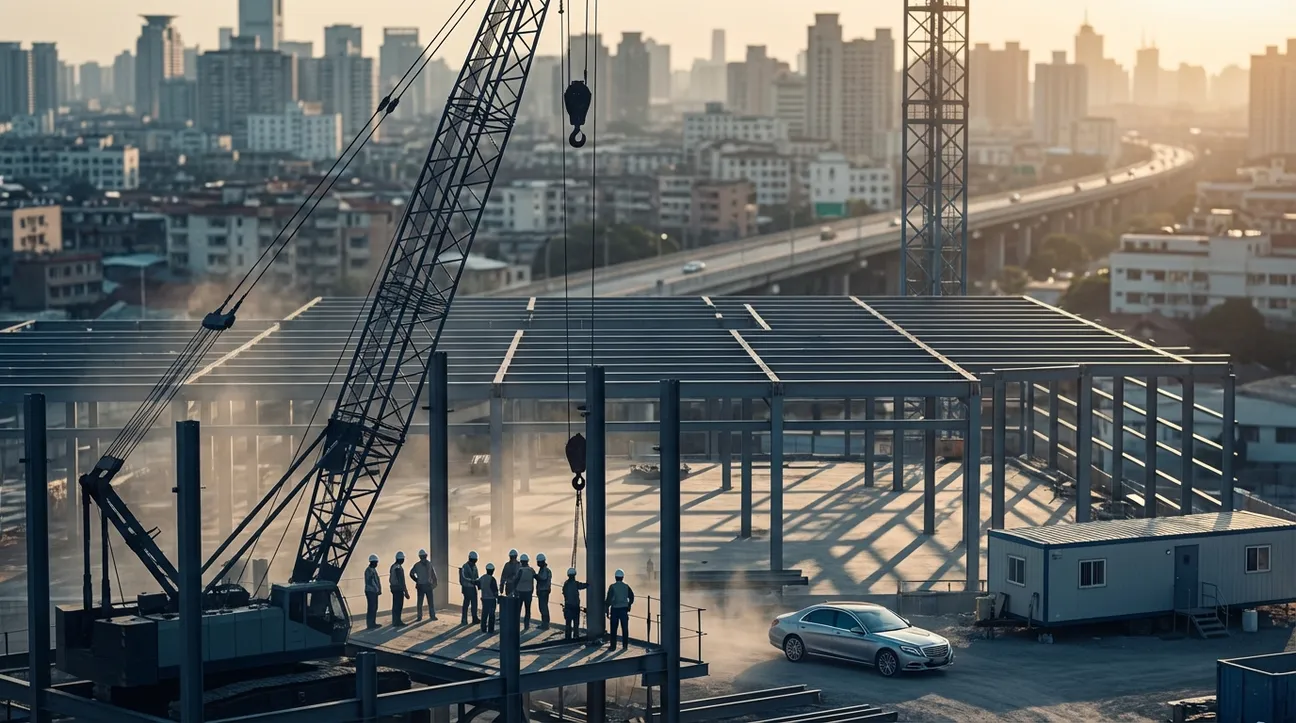
Who safeguards infrastructure in Mexico: from Marcelo Mor to Notary Office 1 in CDMX
The 28.4% drop in public investment forces private capital to strengthen its legal, financial, and notarial structuring chain to operate amid uncertainty.
Executive Summary
Key Takeaways
- Public infrastructure investment fell 28.4% in real terms in 2025, its worst decline since 1991, forcing private capital to take on a larger role.
- The structuring chain—financial advisors, developers, public executors, and notary offices—is essential for attracting institutional capital.
- FDI in Mexico surpassed $40 billion in 2025, a historic record demanding solid legal frameworks.
- Tension between the Article 9 PPP Law reform and the proposed Infrastructure for Well-Being Law creates regulatory uncertainty.
- Data centers and logistics will drive new private infrastructure contracts in 2025-2026.
Physical public investment in infrastructure recorded a real annual decline of 28.4% at the close of 2025, its worst drop since 1991, according to SHCP data reported by Expansión. The figure marks a turning point for Mexico's infrastructure ecosystem: with fewer fiscal resources available, private capital is taking on an increasingly prominent role, and with it, the need for a robust structuring chain that spans from financial strategy to the notarial formalization of every transaction.
This article maps the key players in that chain—often invisible in conventional infrastructure analysis—but essential for ensuring that concessions, trusts, and land acquisitions materialize with legal certainty.
Who are the players that structure and formalize private infrastructure in Mexico?
Structuring a large-scale infrastructure project in Mexico involves at least four layers of players: financial strategists, capital developers, public executors, and legal formalizers. Each fulfills a distinct function, but the chain breaks if any link is missing.
Financial strategy: Marcelo Mor and Alvarez & Marsal
Marcelo Mor is Director of Infrastructure and Capital Projects (I&CP) at Alvarez & Marsal (A&M) for Latin America, according to information from GRI Institute and Alvarez & Marsal (2025). His role involves designing the financial architecture of complex projects, assessing risks, and structuring the investment vehicles that channel capital toward infrastructure assets.
In an environment where public investment is contracting sharply, professionals like Mor become central pieces of the machinery. The ability to structure infrastructure trusts, blended financing models, and public-private partnership schemes with technical rigor largely determines whether a project manages to attract institutional capital or remains at the pre-feasibility stage.
The legal and financial shielding of private infrastructure in Mexico is no longer a complement: it is the entry requirement for institutional capital.
Capital and development: Roberto Moreno Mejía and Amarilo
Roberto Moreno Mejía is President of Amarilo, one of Colombia's largest construction companies, according to information from Amarilo and GRI Real Estate (2025). Although its operational base is Colombian, Amarilo represents a type of Latin American capital that views Mexico with strategic interest, particularly in the housing, logistics, and mixed-use segments.
The presence of regional developers like Amarilo in Mexican infrastructure investment circuits illustrates a significant phenomenon: Foreign Direct Investment (FDI) in Mexico reached a historic record in 2025, exceeding 40 billion dollars, according to the Secretaría de Economía, as reported by El Financiero. This capital flow requires solid legal frameworks to materialize into concrete projects.
Public execution: Rafael Cervantes de la Teja and Salvador Cervantes Loza
On the institutional side, two figures hold strategic roles in public infrastructure execution.
Rafael Cervantes de la Teja serves as Director General of Highway Development at the Secretaría de Infraestructura, Comunicaciones y Transportes (SICT), according to information from the Government of Mexico. His responsibility encompasses the planning and oversight of the federal highway network, the segment that has historically concentrated the largest volume of public-private partnership contracts in the country.
General Salvador Cervantes Loza is Director General of Engineers at SEDENA, responsible for strategic works such as the Tren Maya and IMSS hospitals, according to information from the Government of Mexico (SEDENA, 2024-2025). The military's participation in the direct execution of infrastructure has reshaped the public procurement landscape in Mexico, creating a dynamic where private actors must negotiate with institutional counterparts that differ from traditional ones.
The coexistence of civilian and military executors in Mexican public infrastructure requires private capital to have specialized legal and financial advisory services to navigate increasingly complex procurement schemes.
Legal formalization: the notary offices that certify transactions
The final and frequently underestimated layer of the structuring chain is notarial formalization. In Mexico, no concession, infrastructure trust, land acquisition, or constitution of real guarantees acquires full legal validity without the intervention of a public notary.
Notary Office 1 of Mexico City is headed by Lic. Roberto Núñez y Bandera, a key player in the formalization of major corporate and real estate transactions, according to the Colegio de Notarios de la CDMX (2025). Meanwhile, Notary Office 214 of CDMX is held by Lic. Efraín Martín Virues y Lazos, according to the same source.
These notary offices participate in the constitution of trusts (particularly the administration and guarantee trusts used in infrastructure projects), the notarization of concession contracts, the formalization of strategic real estate purchases, and the certification of shareholder meeting minutes for the special purpose vehicles (SPVs) that channel investment.
Without notarial formalization, an infrastructure trust lacks legal enforceability against third parties, making it an unavoidable requirement for any institutional investor.
How does the new regulatory framework affect project structuring?
The regulatory environment for infrastructure in Mexico is undergoing a significant transition, marked by two legislative developments that directly impact the structuring chain.
The reform to Article 9 of the Public-Private Partnership Law, published on November 14, 2025, in the Diario Oficial de la Federación, aligns the law with the new National Code of Civil and Family Procedures. This modification unifies dispute resolution processes and guarantee enforcement at the national level—a technical change with profound implications for the legal certainty of PPP contracts. By standardizing procedures, the reform reduces the procedural uncertainty that has historically increased litigation costs in infrastructure disputes.
In parallel, the proposed General Law on Infrastructure for Well-Being, championed by Morena legislator Alfonso Ramírez Cuéllar, seeks to repeal the current PPP Law and create a new mixed investment framework with greater state control and oversight through an Infrastructure Commission. This initiative has been under discussion since November 2025.
The tension between both instruments defines the sector's central dilemma. While the Article 9 reform aims to strengthen legal certainty within the existing framework, the Well-Being Law proposal introduces the possibility of a complete reconfiguration of the private participation model.
The public-private investment equation: projections toward 2030
According to statements by Alfonso Ramírez Cuéllar at infrastructure forums, mixed (public-private) investment is projected to grow from 24% to 29% of GDP by 2030 to offset the decline in public budgets. This projection reflects the emerging consensus that the Mexican state will not be able, on its own, to cover the country's infrastructure needs.
According to analyses presented at the GRI Club Mexico Infra & Energy 2025, the data center and logistics market will be the main driver of new private infrastructure contracts in 2025-2026. These segments, fueled by nearshoring and demand for data processing capacity, represent a new frontier where the structuring chain described—from financial strategy to notarial formalization—must operate at peak efficiency.
A chain the market needs to understand
Conventional infrastructure analysis in Mexico tends to focus on the extremes of the value chain: capital sources and the resulting physical assets. Between both extremes operates a structuring ecosystem that includes financial advisors like Alvarez & Marsal, regional developers like Amarilo, public executors like SICT and SEDENA, and legal formalizers like Mexico City's notary offices.
In a context where public investment falls 28.4% in real terms while FDI exceeds 40 billion dollars, the strength of this intermediate chain determines project viability. Infrastructure sector leaders who participate in GRI Institute gatherings increasingly recognize that legal and fiduciary structuring constitutes a differentiating factor for attracting and retaining capital in a transforming political and regulatory environment.
Mexico's infrastructure market lacks neither capital nor projects. It requires every link in the structuring chain to function with precision, from financial design to the notarial seal that grants legal certainty to each transaction.